Bhagavad Gita Verse 15.1: The Mystery of the Inverted Tree
 Minutes to read.
Bhagavad Gita Verse 15.1 Explained
In the opening of Chapter 15, the speaker of the Gita describes the material world as an eternal Peepal tree (Ashwattha) that is uniquely "upside-down." This verse is the key to understanding the hierarchy of the 21 universes and the path to the Supreme God.
The Sanskrit Verse
श्रीभगवानुवाच ऊर्ध्वमूलमधःशाखमश्वत्थं प्राहुरव्ययम् | छन्दांसि यस्य पर्णानि यस्तं वेद स वेदवित् || 1 ||
(ऊर्ध्वमूलम्) ऊपर को पूर्ण परमात्मा आदि पुरुष परमेश्वर रूपी जड़ वाला (अधःशाखम्) नीचे को तीनों गुण अर्थात् रजगुण ब्रह्मा, सतगुण विष्णु व तमगुण शिव रूपी शाखा वाला (अव्ययम्) अविनाशी (अश्वत्थम्) विस्तारित पीपल का वृृक्ष है, (यस्य) जिसके (छन्दांसि) जैसे वेद में छन्द है ऐसे संसार रूपी वृृक्ष के भी विभाग छोटे-छोटे हिस्से या टहनियाँ व (पर्णानि) पत्ते (प्राहुः) कहे हैं (तम्) उस संसाररूप वृक्षको (यः) जो (वेद) इसे विस्तार से जानता है (सः) वह (वेदवित्) पूर्ण ज्ञानी अर्थात् तत्वदर्शी है।
Transliteration: urdhva-mulam adhaḥ-sakham asvatthaṁ prahur avyayam chandasi yasya parṇani yas tam veda sa veda-vit
English Translation: With the roots above in the form of Purna Parmatma Aadi Purush Parmeshwar and the branches below in the form of the three gunas i.e. Rajgun-Brahma, Satgun-Vishnu and Tamgun-Shiv, it is an imperishable, extensive Pipal tree, whose divisions, small-small parts, just as there are verses in Vedas, are said to be twigs and leaves. One, who knows that tree of world in detail, is completely knowledgeable i.e. is Tatvdarshi.
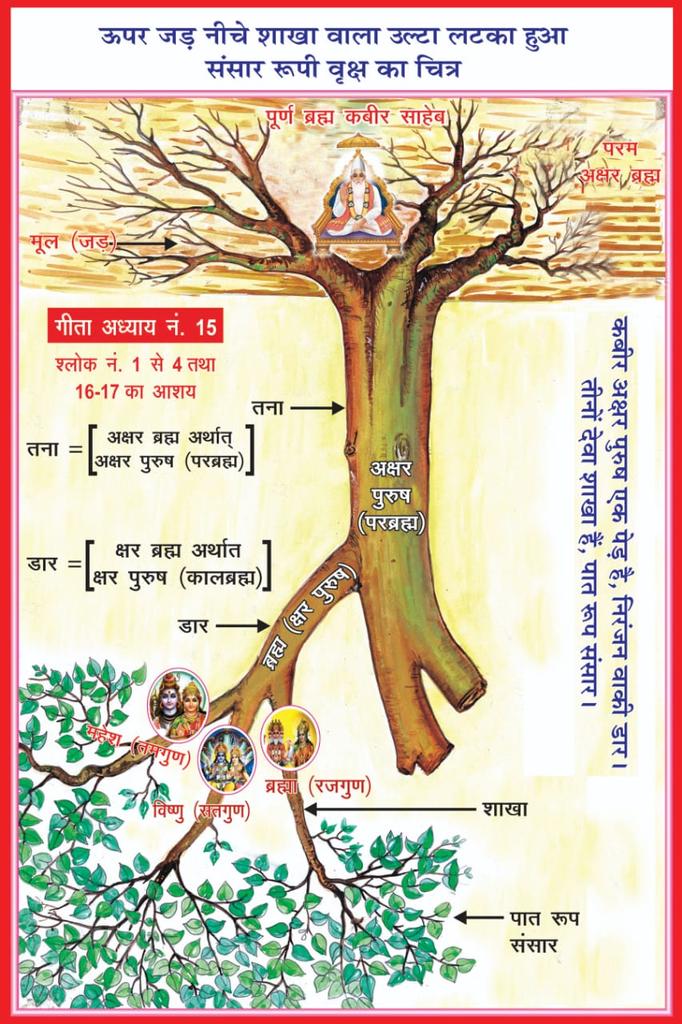
I. Decoding the Symbolism: The Spiritual Anatomy of the Tree
This specific translation reveals that the Ashwattha tree is not merely a metaphor, but a literal map of the divine hierarchy. To understand this tree is to understand the difference between the perishable governors of this world and the eternal source of life.
1. The Root (Above): Purna Parmatma Aadi Purush Parmeshwar
The "Roots Above" refer to the Purna Parmatma (The Complete God), also known as the Aadi Purush Parmeshwar.
- Unlike the trunk or branches, the root is the source of all nourishment.
- This signifies that the Supreme God (Kabir Saheb) resides in the highest spiritual realm (Satlok) and sustains all the universes below Him.
- He is the "Origin" from which the creative energy flows downward.
2. The Trunk: Kaal Brahm (The Giver of the Gita)
While the root is the Supreme God, the trunk of the tree represents Kaal Brahm (Jyoti Niranjan).
- He is the master of the 21 universes and the entity speaking the Gita.
- He stands between the Root (Supreme God) and the Branches (the Trinity).
3. The Branches (Below): The Three Gunas
The branches spreading downwards represent the three functional deities who govern the material world:
- Rajgun-Brahma: The branch of creation.
- Satgun-Vishnu: The branch of preservation.
- Tamgun-Shiv: The branch of destruction. These branches are the three Gunas manifested as persons. Most seekers stay entangled in these branches, never looking up to find the Purna Parmatma at the root.
4. Twigs and Leaves: The Living Beings & Vedic Verses
The translation describes the small-small parts of the tree—the twigs and leaves—as being equivalent to the verses in the Vedas.
- Just as a tree is covered in countless leaves, the material world is filled with countless living beings and rituals.
- These "leaves" provide the external structure and beauty, but they are not the source of salvation. To focus only on the leaves (rituals) without knowing the root is to remain ignorant of the tree's true nature.
II. The Definition of a Tatvdarshi (The Detailed Knower)
The verse concludes with a powerful statement: "One, who knows that tree of world in detail, is completely knowledgeable i.e. is Tatvdarshi."
This changes the traditional understanding of a "scholar." According to this translation:
- Academic Knowledge is not enough: Simply memorizing the Vedas does not make one a "Veda-Vit."
- Structural Knowledge is required: A true Tatvdarshi is one who can explain the entire "Spiritual Anatomy"—identifying the Root, the Trunk, and the Branches exactly as they are.
- The Goal of a Tatvdarshi: Their role is to guide the soul away from the perishable branches (the three Gunas) and reconnect them to the Purna Parmatma Aadi Purush Parmeshwar for permanent liberation.
Frequently Asked Questions (FAQ)
1. How do we reach the "Roots" of this tree?
In Verse 3 and 4 of this same chapter, it is stated that one must cut the attachment to the branches using the "Sword of Detachment" and then seek that Supreme Abode from which no one returns.
2. Is the Giver of the Gita the root of this tree?
No. The speaker (Kaal) says the roots are "above" him. In Verse 17 of this chapter, he explicitly defines the Uttama Purusha (Supreme Person) as someone other than himself who enters and sustains the worlds.
← Chapter 15 in Full Detail Gita 15.3 Meaning: The Speaker's Admission & Pure Tatvgyan →