Bhagavad Gita Chapter 13 Summary: The Field and the Knower
 Minutes to read.
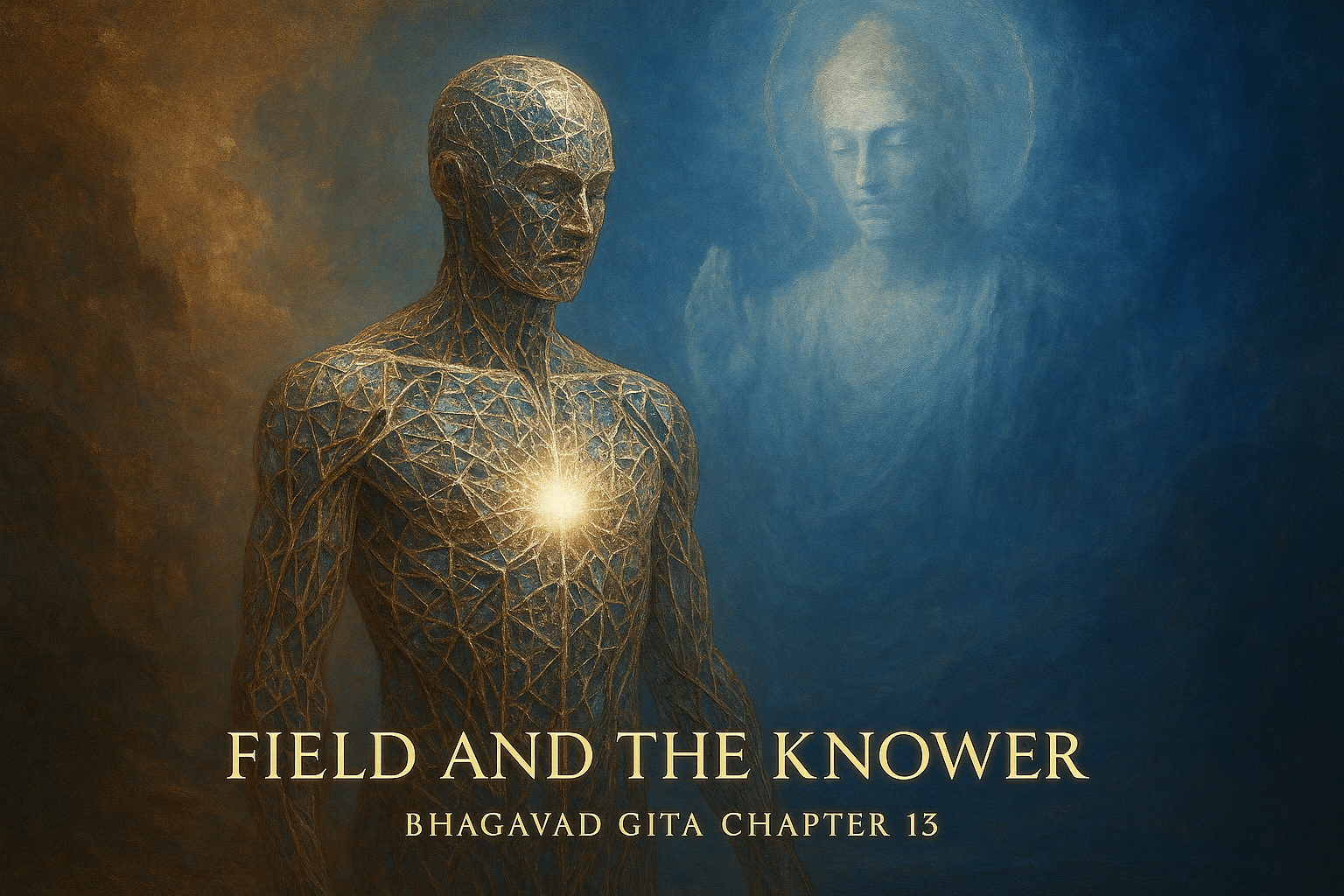
Bhagavad Gita Chapter 13: The Field, the Soul, and the Supreme Overseer
Spiritual Anatomy: Discover the 24 elements of the human body and the "Supreme Overseer" who resides within the heart.
Chapter 13 at a Glance (Key Takeaways)
- The Field (Kshetra): The physical body, consisting of 24 elements, is described as a field where the fruits of Karma are sown and reaped.
- The Knower (Kshetrajna): The soul that inhabits the body and witnesses its actions.
- The Hierarchy of Divine Powers: Understanding the difference between the Soul, the individual Lord (Kaal), and the Supreme Lord (Paramatma).
- True Knowledge Defined: A list of 20 virtues (humility, non-violence, etc.) that constitute real wisdom (Verses 7–11).
I. The Body as a "Field" (Kshetra)
The speaker explains that this body is called the Kshetra. Just as a farmer reaps what he sows in a field, a living being experiences the results of their past actions (Karma) through this physical vessel.
The 24 Elements: The "Field" is composed of the five gross elements (earth, water, fire, air, ether), the ego, intellect, the unmanifested (nature), the ten senses, the mind, and the five objects of the senses.
II. The Three "Purushas" (Beings) within the Body
This is a critical area where your commentary provides clarity that most translations miss. According to Verses 22 and 27, there are three levels of existence within the body:
- The Soul (Jiva): The individual entity experiencing the world.
- The Witness (Kaal/Brahm): The speaker of the Gita, who resides in the body as the "Mahan-Ishwar" (Great Lord) but is still within the cycle of time.
- The Supreme Overseer (Paramatma): The "Upadrashta" (Overseer) and "Anumanta" (Permitter). He is the Supreme God Kabir, who resides in the heart as a silent witness, separate from the destruction of the body.
Key Insight: While the body dies, the Supreme Lord within the body does not perish. To "see" this distinction is the beginning of true liberation.
III. Knowledge vs. Ignorance
In Verses 7–11, the speaker defines "Knowledge" not as information, but as a state of being.
- Humility and Modesty: Absence of pride and arrogance.
- Detachment: Lack of obsession with son, wife, or home.
- Unwavering Devotion: “Mayi cha ananya-yogena bhaktir avyabhicharini”—Devotion to the Divine without straying to other gods.
Evidence: The commentary notes that Verse 10 emphasizes "unswerving devotion to Me." However, the speaker immediately follows up in Verse 22 by pointing to the "Param Purush" (Supreme Being) as the ultimate goal. This confirms that the speaker is a "middle-man" leading the soul toward the Father (Supreme God).
IV. Prakriti and Purusha (Nature and Spirit)
The speaker explains that all actions are performed by Prakriti (Material Nature/Goddess Durga), while the soul is merely the witness.
- The Trap: When the soul identifies with the three Gunas (qualities of nature), it becomes bound to take birth in good or evil wombs (Verse 21).
- The Solution: Recognizing that the soul is separate from the actions of the body.
V. The "Eye of Wisdom"
The chapter concludes with Verse 34:
"Those who perceive with the eye of wisdom the difference between the Field and the Knower... they attain the Supreme."
The Tattvadarshi Connection: Your site emphasizes that this "Eye of Wisdom" is not opened by reading alone. It requires the initiation and Tatvagyan of a True Saint, which allows the soul to actually "see" the Supreme Overseer and escape the "Field" of Kaal's 21 universes.
Frequently Asked Questions (FAQ) - Chapter 13
1. Who is the "Knower of the Field" (Kshetrajna)?
In a limited sense, it is the soul. However, in Verse 2, the speaker says, "Know Me also as the Knower of the Field in all fields." This refers to the all-pervasive nature of the Divine Power.
2. Is the "Supreme Overseer" the same as the Giver of the Gita?
No. In Verse 22, the speaker refers to the Paramatma (Supreme Soul) as "Another" (Anyah) who resides in the body as the ultimate sustainer. This points to the Supreme God Kabir.
3. Why is detachment from family mentioned as "Knowledge"?
It does not mean hating one's family, but rather removing the "delusion of ownership." Since the body is a temporary "Field," all relationships associated with it are also temporary.
← Bhagavad Gita Chapter 12 Summary: The Yoga of Devotion (Bhakti Yoga) Bhagavad Gita Chapter 14 Summary: The Three Gunas of Nature →