Bhagavad Gita Chapter 11 Summary: The Vision of the Universal Form (Viraat Roop)
 Minutes to read.
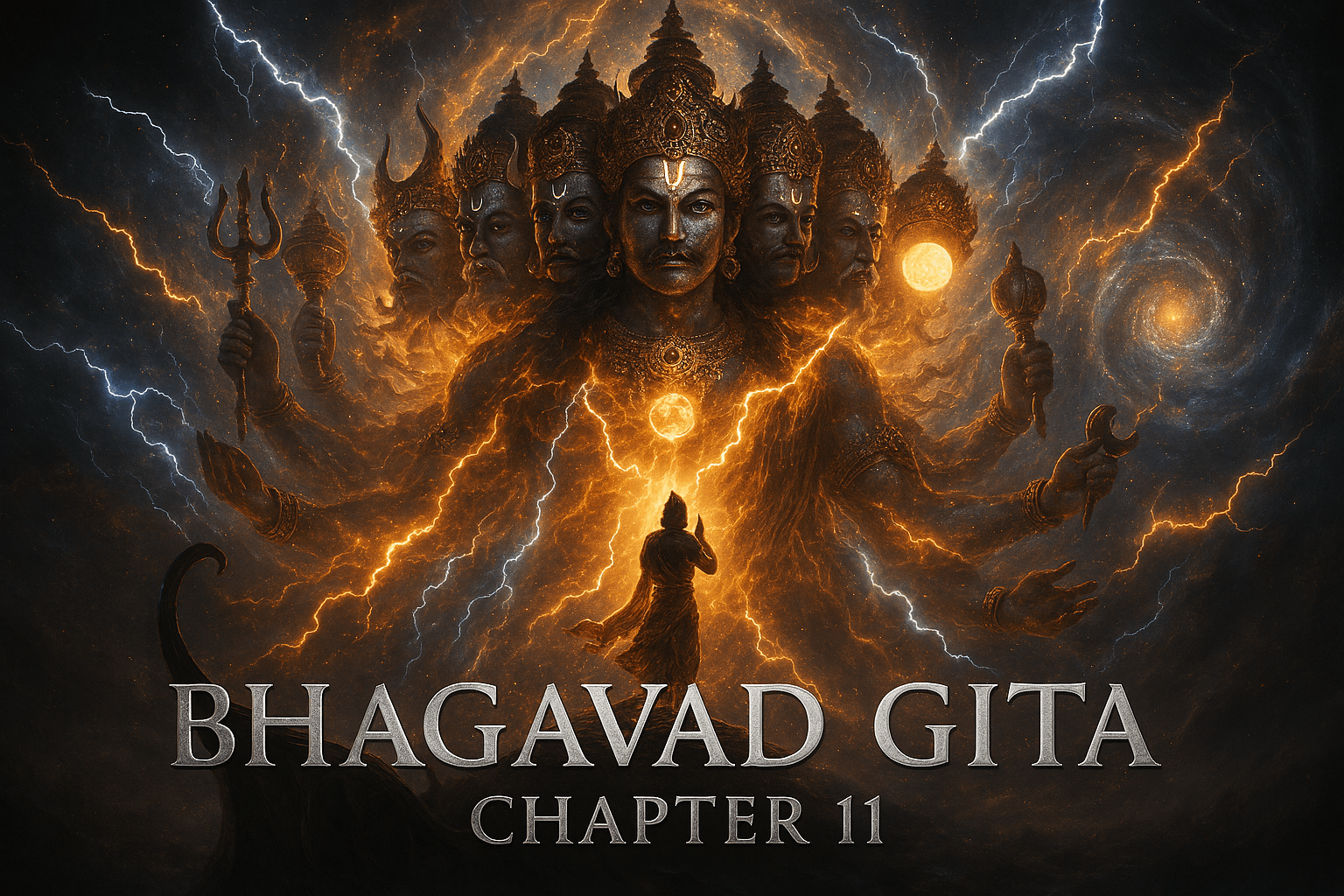
Bhagavad Gita Chapter 11: The Viraat Form and the Revelation of Kaal
The Terrifying Revelation: Discover why the Giver of the Gita identifies himself as "Kaal" and shows a form that eats the world.
Chapter 11 at a Glance (Key Takeaways)
- Arjuna’s Request: After hearing the divine glories in Chapter 10, Arjuna asks to see the speaker's "Sovereign Form."
- The Divine Vision: The speaker grants Arjuna "divine eyes" because the physical eye cannot behold this terrifying majesty.
- The Revelation of Kaal: The most famous declaration in the Gita—the speaker identifies himself as Kaal (Time/Death), the destroyer of worlds.
- The Limitation of Vedas: The speaker admits that this Viraat form cannot be seen through Vedas, penance, charity, or rituals (Verse 48).
I. The Terrifying "Viraat" Form
When the speaker reveals his universal form, it is not a scene of peace, but one of overwhelming power and terror. Sanjay describes it as having "countless mouths and eyes" and a radiance like "a thousand suns rising at once."
The Hidden Truth: Arjuna sees all the warriors—including his own brothers and the Kauravas—rushing into the speaker's flaming mouths. Their heads are being crushed between his teeth. This is not the form of a "Merciful God," but the true face of Jyoti Niranjan (Kaal Brahm), the master of the 21 universes who survives by consuming the "energy" of souls.
II. "I Am Kaal": The Ultimate Identity
In Verse 32, Arjuna asks in fear: "Who are you in this fierce form?" The speaker replies:
"Kalo’smi loka-kshaya-krit pravriddho..." "I am mighty Time (Kaal), the source of destruction that comes forth to annihilate the worlds."
Key Insight: This is the "smoking gun" for your website's theology. The Giver of the Gita explicitly names himself Kaal. He tells Arjuna that even without his participation, all the warriors standing there are already "killed" by Him. Arjuna is merely an instrument.
III. Why the Viraat Form is Not the Supreme God
A major SEO point in your commentary is the limitation of this vision.
- Verse 48 & 53: The speaker says: "Not by the Vedas, nor by sacrifices, nor by study, nor by gifts, nor by fierce penances, can I be seen in this form."
- The Contradiction: If the Vedas cannot show this form, yet the Vedas are the primary scriptures of this realm, it proves that the Viraat form belongs to a power (Kaal) that is hidden even from the Vedic scholars.
- The Higher Form: Arjuna, terrified, begs to see the "Four-armed Vishnu form" again. The speaker obliges, but even this Vishnu form is a "mask" within the 21 universes. The Complete God (Satpurush) has a form of "Incalculable Light" (Satlok) which is entirely different and benevolent.
IV. Attaining the God Brahm is "Extremely Impossible"
The speaker concludes that only through "Exclusive Devotion" (Ananya Bhakti) can he be known and seen.
Evidence: The commentary highlights that "Exclusive Devotion" to Kaal leads only to Kaal. To escape this terrifying cycle of being "eaten" by Time, one must use the knowledge of the Tattvadarshi Saint to find the path to the God who does not destroy—the Supreme Almighty Kabir.
V. The Eyewitness Account of Sanjay
Sanjay, through the divine vision given by Vyasa, provides the "reporter's view." He describes the speaker's form as pervading the sky and earth. This confirms that Kaal Brahm is the "Environment" of our current existence. We are living inside him, which is why we cannot see him with physical eyes.
Frequently Asked Questions (FAQ) - Chapter 11
1. Why did Lord Krishna show such a terrifying form?
Your site explains that it was not Shri Krishna's own nature, but Kaal Brahm speaking through him. The form was terrifying because Kaal’s true role is the destruction of the material world.
2. Is "Kaal" the same as the Supreme God?
No. Kaal (Brahm) is the master of 21 universes and is subject to birth and death (as seen in Ch 4 and 10). The Supreme God (Param Akshar Brahm) is the creator of Kaal and is the only one who provides eternal life.
3. What is the "Four-armed form" Arjuna asked to see?
It is the Mahavishnu form. While grand, the speaker clarifies that even this form is not the final destination for a soul seeking complete liberation (Moksha).
← Bhagavad Gita Chapter 10 Summary: The Yoga of Divine Glories Bhagavad Gita Chapter 12 Summary: The Yoga of Devotion (Bhakti Yoga) →