Bhagavad Gita Chapter 4 Summary: The Knowledge of Divine Birth and Action
 Minutes to read.
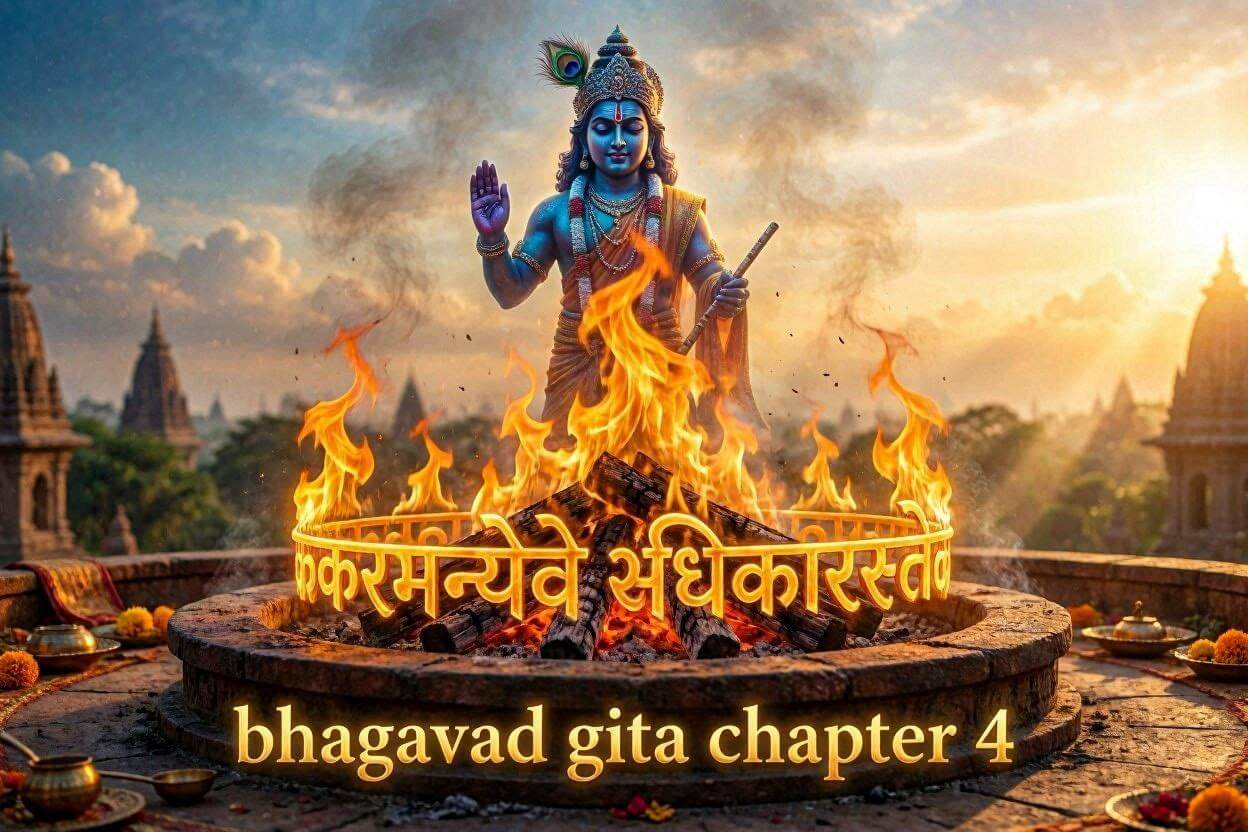
Uncover the mystery of the Giver of the Gita’s reincarnation and the mandatory role of a Tattvadarshi Saint in achieving Moksha.
Chapter 4 at a Glance (Key Takeaways)
- Eternal Knowledge: The speaker reveals that this Yoga is ancient and was first given to the Sun-god, Vivasvan.
- The Cycle of Birth: The Giver of the Gita admits that both he and Arjuna have passed through many births, but only he remembers them (Verse 5).
- The Divine Secret: Why God appears on Earth and the difference between the "Web of Kaal" and the path to the Supreme.
- The Tattvadarshi Saint: The famous Verse 34, which commands seekers to find a "Knower of Truth" to understand the essence of God.
I. The Reincarnation of the Giver of the Gita
The chapter begins with a startling revelation. Arjuna asks: "You were born recently, but the Sun-god was born ages ago. How can I believe you taught him?"
The Hidden Truth: In Verse 5, the speaker says: "Many births of mine and yours have passed; I know them all, but you do not." This is vital evidence for Gita's core message. If the speaker is subject to many births and deaths, he is not the Complete God (Purna Brahm), who is eternal and never takes birth from a mother’s womb. The speaker is Kaal Brahm, the administrator of the 21 universes, who remains trapped in his own cycle of time.
II. The Purpose of Divine Appearance (Avtar)
In Verses 7-8, the speaker explains that whenever righteousness (Dharma) declines, he manifests himself to protect the "Sadhus" and destroy the "evil-doers."
Key Insight: While traditional views see this as the ultimate act of God, this commentary explains that this is the duty of Kaal to maintain order in his prison (this world). To achieve Complete Liberation, one must look beyond these periodic descents and find the God who resides in the "Third Abode" (Satlok), who does not need to kill to protect.
III. Different Types of Yagyas (Sacrifices)
The speaker describes various forms of sacrifice—some offer material goods, some offer their breath (Pranayama), and others offer their senses.
- The Conclusion: Knowledge-sacrifice (Gyan Yagya) is superior to material sacrifice.
- The Warning: Even the most dedicated practitioners remain in the bondage of Karma if they do not understand the "Name" (Mantra) that destroys sins.
IV. The Mandatory Search for a Tattvadarshi Saint
The "Crown Jewel" of Chapter 4 is Verse 34:
"Learn the Truth by approaching a Tattvadarshi Saint. Inquire from them with humility and service; those Knowers of Truth will instruct you in that Knowledge."
Why is this important?
- Direct Instruction: The Giver of the Gita admits his own knowledge is not "complete" for final salvation. He directs Arjuna (and us) to find a specialized teacher.
- Recognition: A Tattvadarshi Saint is one who can explain the "Upside-Down World Tree" (Chapter 15) in full detail.
- Destruction of Sins: In Verse 37, it is said that the "Fire of Knowledge" reduces all Karmas to ashes. This commentary highlights that only a True Guru can ignite this fire.
V. The Bondage of Karma and the Three Worlds
The speaker confirms that even the "Lords of the Three Worlds" (Brahma, Vishnu, and Shiva) are not spared from the bondage of Karma. People mistakenly believe their spiritual practices are destroying their sins, but without the correct method provided by a Tattvadarshi Saint, they are merely trading one type of bondage for another.
Frequently Asked Questions (FAQ) - Chapter 4
1. Who is a Tattvadarshi Saint according to the Gita?
A Tattvadarshi Saint is a "Knower of the Essence." As per Chapter 15, Verses 1-4, he is the one who correctly identifies the roots, trunk, and branches of the World Tree.
2. Does the Giver of the Gita also die?
Yes. Verse 5 and Verse 9 provide evidence that the speaker undergoes birth and death. This is why the salvation he provides is called "Anuttam" (inferior/bad) in Chapter 7, Verse 18.
3. Can we attain God through Penance or Charity alone?
No. The speaker concludes that while these are good actions, only the "Sacrifice of Knowledge" and the refuge of a True Saint lead to the state from which one never returns to this world.
← Bhagavad Gita Chapter 3 Summary: The Secret of Karma Yoga Bhagavad Gita Chapter 5 Summary: The Yoga of True Renunciation →