Bhagavad Gita Chapter 15 Summary: The Yoga of the Supreme Person
 Minutes to read.
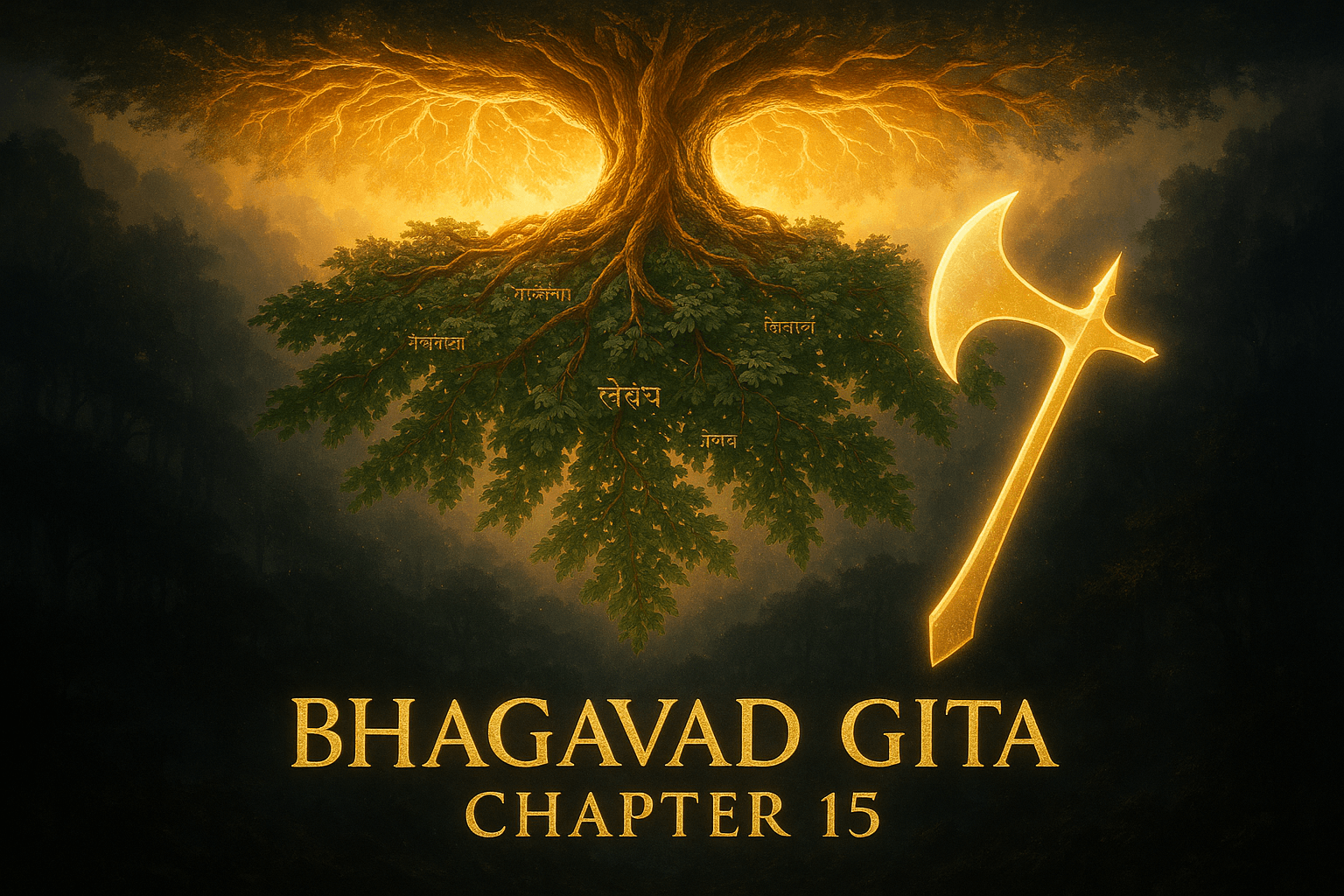
Bhagavad Gita Chapter 15: The World Tree and the Supreme Person
The Map of the Universe: Decode the Upside-Down World Tree and discover the identity of the "Third Being" who sustains the worlds.
Chapter 15 at a Glance (Key Takeaways)
- The Inverted Tree: The description of the material world as a Peepal tree with roots above and branches below.
- Cutting the Tree: Why the "Sword of Detachment" is necessary to sever the soul's connection to the three Gunas.
- The Three Purushas: The final revelation that there are two "Purushas" in this world, but a Third Supreme Being who is separate from them.
- The Goal: Reaching the "Supreme Abode" (Satlok) from which there is no return to the world of sorrow.
I. The Mystery of the Upside-Down Tree
The chapter begins with a profound metaphor of a Peepal tree (Verses 1–3):
"He who knows the Peepal tree with its roots above and branches below, whose leaves are the Vedas, is the knower of the Vedas."
The Hidden Truth: The commentary provides the decryption of this map:
- The Roots (Top): Represent the Supreme God (Param Akshar Purush), the source of all life.
- The Trunk: Represents Kaal Brahm (Jyoti Niranjan), the speaker of the Gita.
- The Branches (Bottom): Represent the Three Gunas (Brahma, Vishnu, and Shiva).
- The Leaves: Represent the worldly rituals and Vedic hymns that keep the soul entangled.
To be a "Knower of the Vedas," one must understand this hierarchy. If you only worship the branches (Brahma, Vishnu, Shiva), you are ignoring the Root that sustains the entire tree.
II. Cutting the Roots with the "Sword of Detachment"
The speaker admits that the "true form" of this tree cannot be perceived in this world. In Verse 3 and 4, he gives the solution:
- Cut down this deep-rooted tree with the Strong Sword of Detachment (Vairagya).
- Then, seek that Supreme Abode (Satlok), where, having gone, no one ever returns.
Key Insight: One must seek refuge in the "Primeval Purusha" from whom the ancient creative energy flows. This confirms that the speaker is directing Arjuna away from himself and toward a higher power.
III. The Migration of the Soul
In Verses 7–9, the speaker explains how the soul moves. A fragment of the Divine (the soul) enters the material world and draws to itself the six senses, including the mind.
- When the soul leaves the body, it takes these senses with it, just as the wind carries fragrance from its source.
- The soul then enjoys the objects of the senses through a new physical body.
IV. Kshara, Akshara, and Purushottama
This is the theological climax of the Gita (Verses 16–18). The speaker defines three types of "Purushas":
- Kshara (Perishable): All living beings in the material world and the speaker himself (Kaal) who is subject to time.
- Akshara (Imperishable): The soul and the being who stays unchanged throughout the cycles of this universe.
- Uttama Purusha (The Supreme Person): The "Paramatma" (Supreme Soul).
"But there is another, the Supreme Person, called the Supreme Soul, who, as the imperishable Lord, enters the three worlds and sustains them."
Evidence: The speaker identifies himself as "Purushottama" only because he is superior to the perishable beings of this world. However, he acknowledges the "Other" (Uttama Purusha) who is the true sustainer. This "Other" is Kabir Saheb, the Supreme Almighty.
V. The Sun, Moon, and Fire
The speaker claims that the light of the sun, the moon, and the fire comes from Him (Verse 12). The Deeper Context: While this power is channeled through the master of this universe (Kaal), the original "powerhouse" is the Supreme God in Satlok. Just as a bulb glows because of the distant power plant, the sun glows because of the energy of the Supreme Creator.
Frequently Asked Questions (FAQ) - Chapter 15
1. What does the "Upside-Down Tree" represent?
It represents the hierarchy of the universe. The roots at the top are the Supreme God (Kabir), the trunk is Kaal Brahm, and the branches are the three Gunas (Brahma, Vishnu, and Shiva).
2. Who is the "Purushottama" mentioned in Chapter 15?
The speaker calls himself Purushottama in the context of this material world (Kshara). However, he also points to the Uttama Purusha (Supreme Person) who is higher than him and sustains all three worlds.
3. How can we reach the "Abode of No Return"?
One must find a Tattvadarshi Saint who can explain the mystery of the tree (as stated in Chapter 4, Verse 34) and provide the correct method of worship to reach Satlok.
← Bhagavad Gita Chapter 14 Summary: The Three Gunas of Nature Bhagavad Gita Chapter 16 Summary: The Divine and Demonic Nature →