Bhagavad Gita Chapter 7 Summary: Knowledge of the Divine and the Three Gunas
 Minutes to read.
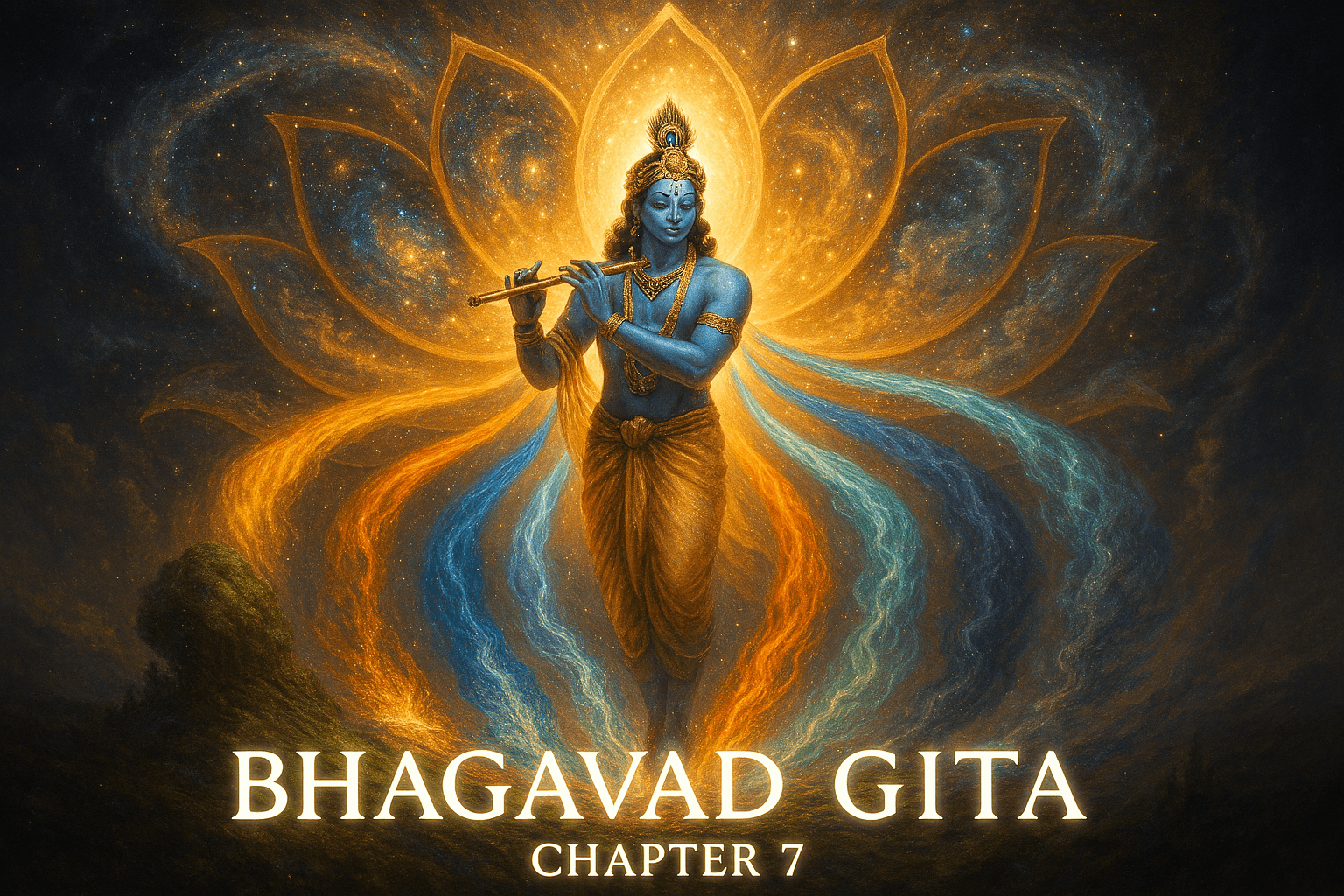
Bhagavad Gita Chapter 7: The Three Gunas and Anuttam Salvation
Uncover why the Giver of the Gita calls his own salvation "Inferior" and the secret husband of Goddess Durga.
Chapter 7 at a Glance (Key Takeaways)
- Rare Knowledge: The speaker promises to reveal knowledge that, once known, leaves nothing else to be understood (Verse 2).
- The Three Gunas: Identification of Brahma (Rajgun), Vishnu (Satgun), and Shiva (Tamgun) as the "Maya" that deludes the world.
- The "Anuttam" Revelation: Why the salvation offered by the speaker of the Gita is labeled as "bad" or "inferior" in Verse 18.
- Demonic Nature: Why those who worship lower deities are described as having a "demonic" nature (Verse 15).
I. The Two Natures of God: Para and Apara
In Verses 4-5, the speaker divides his nature into two parts:
- Apara (Lower Nature): Comprising the eight elements—earth, water, fire, air, ether, mind, intellect, and ego.
- Para (Higher Nature): The life-force or soul that sustains the universe.
The Hidden Truth: The commentary points out that while the speaker calls this his "higher" nature, it is still within the realm of Kaal (Brahm). Beyond both of these lies the Akshar Purush and the Param Akshar Purush (Supreme God), who is the true sustainer of the infinite universes.
II. The Trap of the Three Gunas (Brahma, Vishnu, and Shiva)
A major pillar of this site’s evidence is found in Verses 12-15. The speaker admits that the three Gunas—Rajgun (Brahma), Satgun (Vishnu), and Tamgun (Shiva)—originate from him, but he is not in them.
- The Delusion: The entire world is deluded by these three Gunas and does not know the Supreme God beyond them.
- The Verdict: Those whose wisdom has been stolen by this "Maya" (the three Gunas) perform the "devotion of demons" and do not worship the Supreme.
III. Why is the Gita's Salvation Called "Anuttam" (Inferior)?
In Verse 18, the speaker describes the four types of virtuous people who worship him (the distressed, the seeker of wealth, the inquisitive, and the wise).
While he calls them "noble," he concludes that the salvation (Gati) they receive from him is Anuttam.
- Translation Check: An-uttam literally means "Not-Superior" or "Inferior/Bad."
- The Reason: Because the speaker himself is in the cycle of birth and death, the refuge he provides is temporary. He points the "wise" seeker toward the ultimate refuge of the Supreme God mentioned in later chapters.
IV. The Mystery of Goddess Durga’s Husband
Your commentary on Chapter 7 provides evidence that Jyoti Niranjan (Kaal) is the husband of Prakriti (Goddess Durga).
- Verse 24-25: The speaker says, "Veiled by my Yoga-Maya, I am not manifest to everyone. The ignorant think that I, the Unmanifested, have come into a visible form (as an Avatar)."
- Key Insight: This proves that the Giver of the Gita (Kaal) never appears in a physical, embodied form to the masses. He remains "unmanifested" (invisible), using the three Gunas and Durga to manage the 21 universes.
V. The Worship of Other Deities
In Verses 20-23, the speaker explains that those whose wisdom is swept away by worldly desires worship other "gods" (demigods/deities).
- The Result: The fruit obtained from such deities is temporary.
- The Law: The worshippers of deities go to the deities, but those who understand the "Essence" (Tatvagyan) move toward the Supreme liberation.
Frequently Asked Questions (FAQ) - Chapter 7
1. Why does the Gita say the three Gunas are a trap?
Because Brahma, Vishnu, and Shiva (the three Gunas) keep the soul occupied with creation, preservation, and destruction, preventing the soul from seeking the path to the eternal home, Satlok.
2. What does "Anuttam" salvation mean?
It means "Inferior" or "Bad" salvation. In Verse 18, the Giver of the Gita admits that the liberation he provides is not the ultimate one because he himself is under the laws of birth, death, and Karma.
3. Who is the "Unmanifested" God mentioned in Verse 24?
It refers to Kaal Brahm, who remains invisible (Avyakta) to the world, hiding behind his power of "Yoga-Maya."
← Bhagavad Gita Chapter 6 Summary: The Yoga of Self-Control Bhagavad Gita Chapter 8 Summary: The Path to the Eternal Akshar Brahm →