Bhagavad Gita Chapter 18 Summary: The Yoga of Liberation
 Minutes to read.
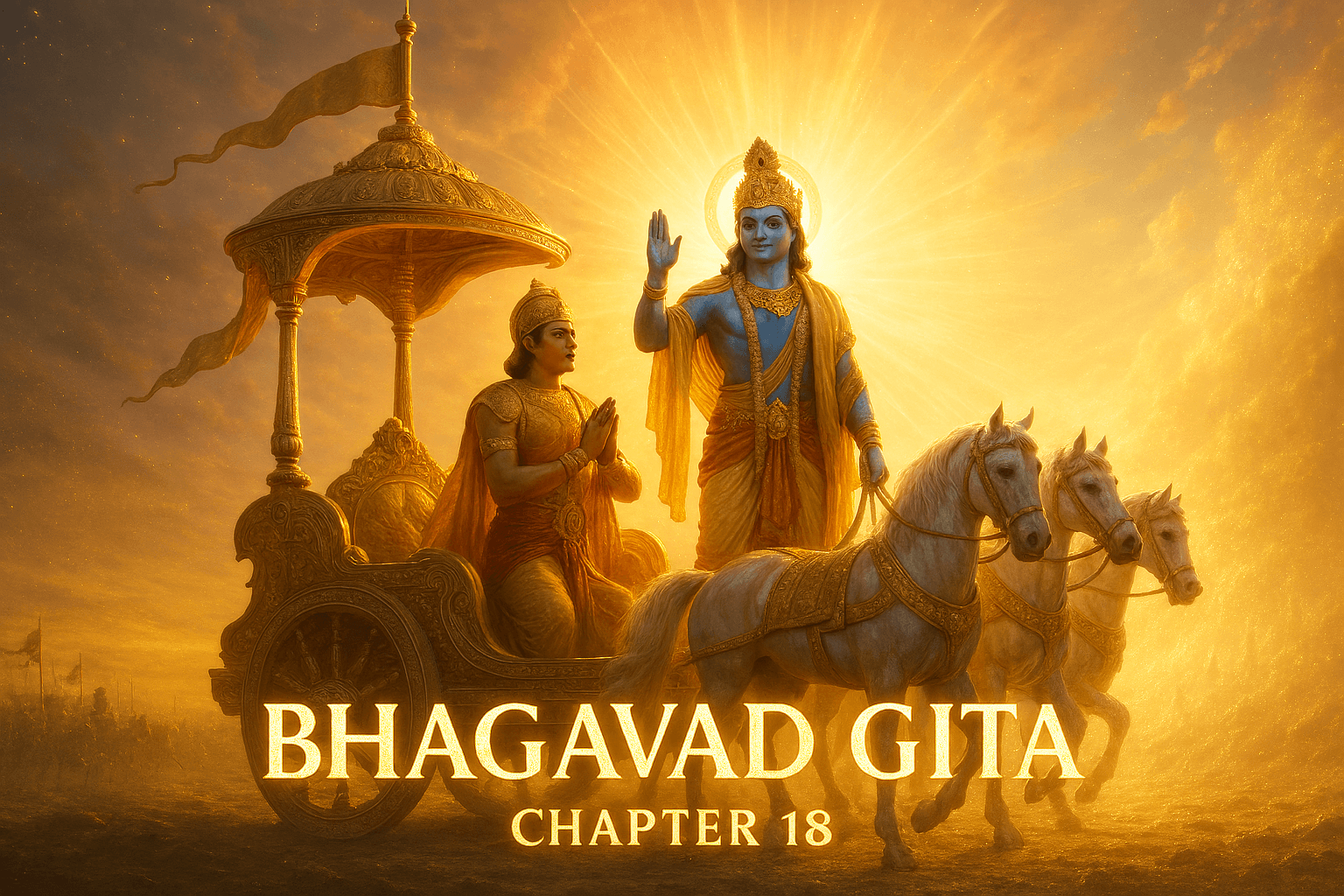
Bhagavad Gita Chapter 18 Summary: The Final Path to Liberation
The Final Verdict: Discover the speaker's last instruction to seek a "Higher God" and the secret to total freedom from Karma.
Chapter 18 at a Glance (Key Takeaways)
- Renunciation (Tyaga): The difference between giving up actions and giving up the attachment to the fruits of action.
- The Five Factors of Action: Understanding that the soul is not the sole "doer" of any task.
- The Three Gunas in Everything: How the Gunas influence our intellect, resolve, and happiness.
- The Ultimate Secret: Verse 62 and 66—the direct command to take refuge in the Supreme Almighty.
I. Sanyas vs. Tyaga: True Renunciation
Arjuna asks for the final word on the difference between Sanyas (renunciation) and Tyaga (relinquishment).
- The Speaker’s View: True renunciation is not about wearing saffron clothes or living in a forest. It is the abandonment of the desire for rewards.
- Essential Duties: The speaker insists that acts of Yagya (sacrifice), Daana (charity), and Tapa (penance) should never be abandoned, as they purify the wise.
II. The Five Factors of Every Action
To remove the ego of "I am the doer," the speaker lists the five components required for any action to manifest (Verses 14–15):
- The Body (Adhishthanam)
- The Doer/Ego (Karta)
- The Senses/Organs (Karanam)
- The Various Efforts (Cheshta)
- The Divine/Destiny (Daivam)
Key Insight: Since four of these five factors are material and governed by the laws of Kaal, the soul is merely a witness. Realizing this prevents the accumulation of new Karmic debt.
III. The Three Types of Happiness
The Gita categorizes happiness to help us audit our lives:
- Sattvic Happiness: Feels like poison at first but ends like nectar (discipline, meditation).
- Rajasic Happiness: Feels like nectar at first but ends like poison (sensual pleasures).
- Tamasic Happiness: Delusive from beginning to end (sleep, laziness, intoxication).
IV. The "Supreme Secret" and the Final Command
As the dialogue ends, the speaker gives his most direct advice. This is the most important evidence for your website's mission.
The Refuge of "That" God (Verse 62)
"Flee unto Him for shelter with all thy being, O Bharata. By His grace, thou shalt obtain Supreme Peace and the Eternal Abode."
The Hidden Truth: The speaker says "Go to HIM" (not "Come to Me"). This confirms that the Giver of the Gita is pointing to a separate, higher Power—the Supreme God Kabir.
The Abandonment of Religions (Verse 66)
"Abandoning all varieties of religious practices (Dharmas), surrender unto Him alone. I shall liberate you from all sins; do not grieve."
The Contextual Correction: While this verse is often used to promote "Krishna-only" worship, the commentary clarifies the hierarchy. After explaining the entire system, the speaker tells Arjuna to stop performing the "arbitrary religious practices" of the three Gunas (Brahma, Vishnu, Shiva) and himself and follow the path he has just laid out and seek the refuge of the Supreme God for complete liberation. He says, the "Ultimate Refuge" remains the one mentioned in Verse 62. Other translators have translated the meaning of "Vraj" incorrectly.
V. The Result of Hearing the Gita
Arjuna finally declares in Verse 73: "My delusion is destroyed. I have regained my memory (of my true soul) by Your grace. I am firm, my doubts have vanished, and I will act according to Your word."
The Final Blessing: Sanjay concludes the Gita by stating that wherever there is Krishna (the Giver of Knowledge) and Arjuna (the dedicated Seeker), there will be prosperity, victory, and morality.
Frequently Asked Questions (FAQ) - Chapter 18
1. What is the difference between Verse 62 and Verse 66?
Verse 62 is the "target"—the Supreme God and the Eternal Abode. Verse 66 is the "process"—abandoning the lower, unscriptural methods of the three Gunas to focus on the path of the Divine.
2. Why does the Gita emphasize "Duty" so much?
Because while we are in the body, we are "tenants" in the 21 universes of Kaal. We must perform our worldly duties to settle our local Karmic accounts, while simultaneously performing "Sat-Bhakti" to escape the cycle permanently.
3. Is the "Eternal Abode" mentioned in Chapter 18 the same as Heaven?
No. Heaven (Swarga) is temporary. The "Eternal Abode" (Satlok) is the place from which no soul ever returns to this world of death.
← Bhagavad Gita Chapter 17 Summary: The Yoga of Threefold Faith Insight →