Bhagavad Gita Chapter 17 Summary: The Yoga of Threefold Faith
 Minutes to read.
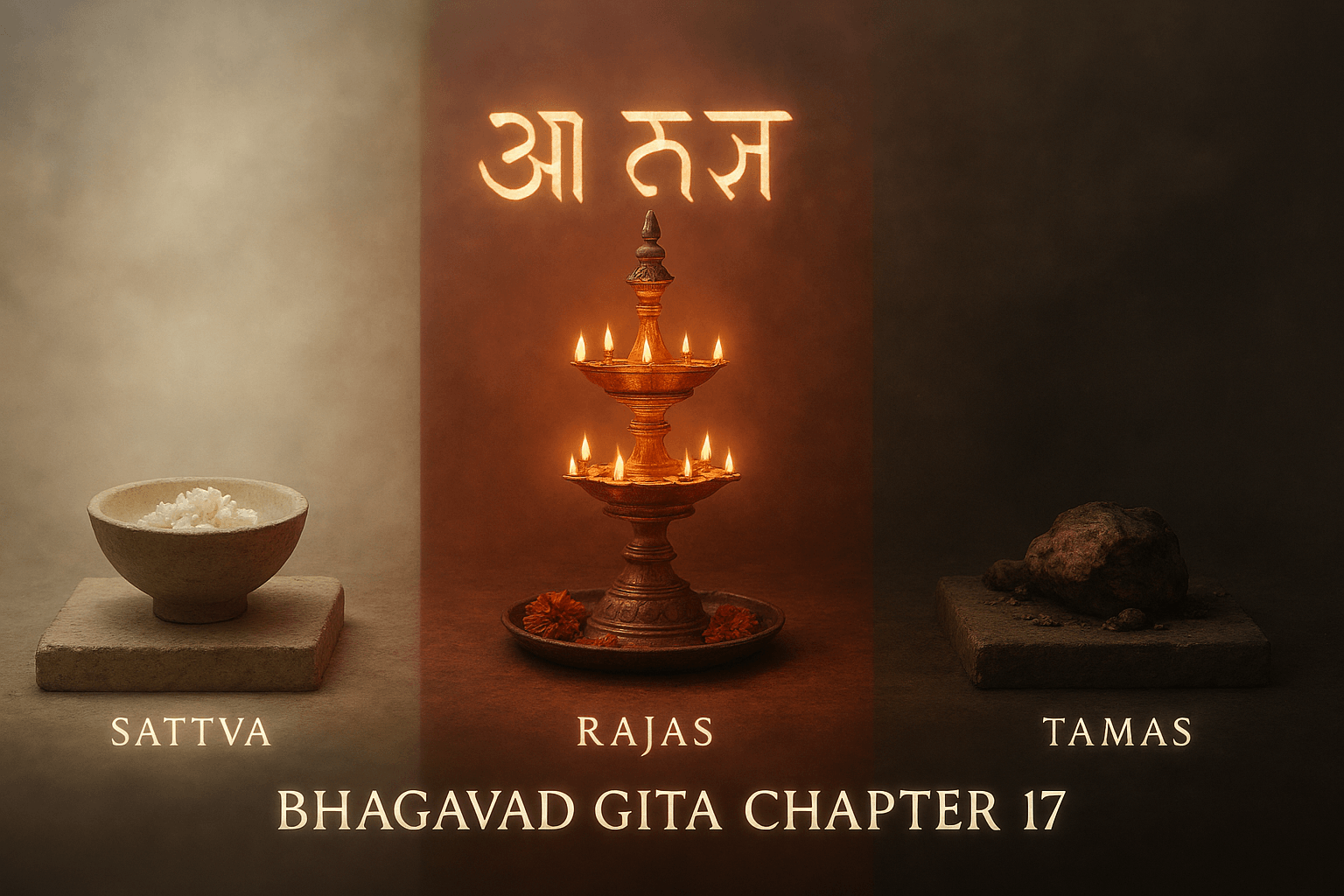
Bhagavad Gita Chapter 17: OM TAT SAT & The Science of Threefold Faith
Decoding the Mantra "OM TAT SAT": Learn the correct way of worship and the food that leads to spiritual purity.
Chapter 17 at a Glance (Key Takeaways)
- Faith Defined: The speaker explains that a person's faith is shaped by their nature (Sattva, Rajas, or Tamas).
- The Threefold Diet: How the food you eat affects your mind and spiritual progress.
- Penance (Tapa): Why "Hatha Yoga" and self-torture are classified as demonic.
- The Secret Mantra: The revelation of OM TAT SAT as the designated name for the Supreme God (Verse 23).
I. Faith According to the Gunas
Arjuna asks: "What is the state of those who perform worship with faith but ignore the rules of the scriptures?"
- Sattvic Faith: Worship of the gods (Deities/Vishnu).
- Rajasic Faith: Worship of powerful beings and demons (Yaksas/Rakshasas).
- Tamasic Faith: Worship of spirits and ghosts (Pretas/Bhutas).
The Hidden Truth: While Arjuna asks about those who ignore the scriptures, the speaker clarifies that their "faith" is still bound by the material world. As established in Chapter 16, worship without scriptural authority leads to no benefit.
II. The Science of Food and Charity
The Gita provides a practical guide to living.
- Sattvic Food: Juicy, smooth, and nourishing foods that promote longevity and health.
- Rajasic Food: Excessively bitter, sour, salty, hot, or pungent foods that cause pain and grief.
- Tamasic Food: Stale, tasteless, putrid, or impure food (including meat and alcohol).
Charity (Daana): Charity given to a worthy person at the right time and place without expectation of return is Sattvic. Charity given reluctantly or for fame is Rajasic, and charity given at the wrong time to the unworthy is Tamasic.
III. Austerity: Body, Speech, and Mind
The speaker defines "True Penance" as being non-violent, truthful, and self-controlled.
- The Warning: In Verses 5-6, the speaker warns that those who perform "terrible penances" not enjoined by the scriptures—torturing their own bodies and the "Indwelling God"—are of demonic resolves.
Evidence: This directly refutes the practices of many "fake saints" who sit on nails, hold their arms up for years, or perform extreme fasts. True worship is simple and mental.
IV. The Secret of "OM TAT SAT" (Verse 23)
This is the most critical SEO point for your website. In Verse 23, the speaker reveals the "formula" for attaining the Supreme:
"OM TAT SAT—this has been declared as the triple designation of Brahman (the Supreme God) at the beginning of creation."
The Deep Meaning: 1. OM: The mantra for worshipping Brahm (Kaal). It provides worldly benefits and reaches up to the 21st universe. 2. TAT: This is a coded mantra for the Akshar Purush. It is used to cut the bondage of the 21 universes. 3. SAT: This is the mantra for the Param Akshar Purush (Satpurush/Kabir). It leads the soul to the eternal home, Satlok.
Key Insight: Without this three-stage mantra, liberation is impossible. Most scholars only know "OM," but the "TAT" and "SAT" mantras are only revealed by a Tattvadarshi Saint.
V. "Asat": Worship Without the Name
The chapter concludes with Verse 28, stating that any sacrifice, gift, or penance performed without faith (and without the correct Name) is called "Asat" (unreal/false). It is of no use here or hereafter.
Frequently Asked Questions (FAQ) - Chapter 17
1. What is the significance of "OM TAT SAT"?
It is the only mantra that can grant complete salvation. Each word targets a different power (Kaal, Akshar, and Satpurush). It must be received from a True Guru to be effective.
2. Is being a vegetarian required in the Gita?
Chapter 17 classifies meat and stale food as "Tamasic," which leads to ignorance and lower births. For spiritual progress, a "Sattvic" diet is essential.
3. Why is arbitrary penance called demonic?
Because it tortures the body and the soul. God does not demand physical suffering; He demands the surrender of the ego and the mind through the "True Name."
← Bhagavad Gita Chapter 16 Summary: The Divine and Demonic Nature Bhagavad Gita Chapter 18 Summary: The Yoga of Liberation →