Loading...

Chapter 15

/ Chapter 15

Chapter 15

Minutes to read.

Summary of Gita Chapter 15

Verses 1–4

Description of the World-Like Tree

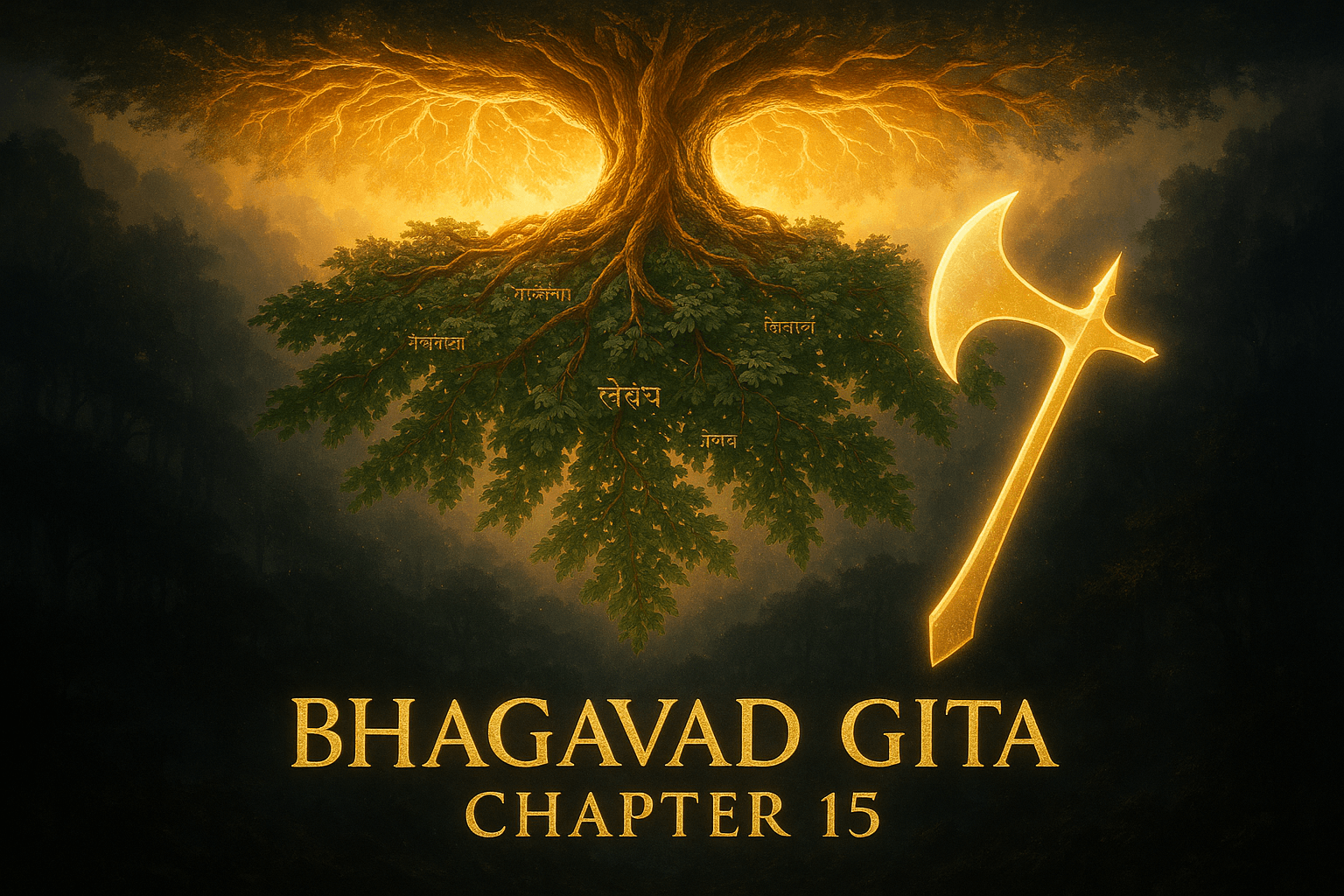
Gita Chapter 15, Verse 1: It is stated that there is an imperishable, extensive world-tree. Its roots (the Supreme God) are above, and its branches are the three qualities (Rajogun Brahma, Sattvagun Vishnu, Tamogun Shiva) below. It is like a Pipal tree with various boughs, twigs (minor branches), and leaves. He who knows the entire structure of this world-tree is a truly learned person or a Tattvadarshi Saint who understands the essence of the Vedas.

Almighty Kabir says:

Akshar Purush ek ped hai, Niranjan (Brahm) vaaki dhaar | Teeno deva shaakha hain, paat roop sansaar || (Akshar Purush is the trunk of the tree; Niranjan/Brahm is the main bough. The three gods—Brahma, Vishnu, Mahesh—are the branches, and the world consists of the leaves.)

Kabir, hum hi Alakh Allah hain, mool roop Kartaar | Anant koti brahmand ka, main hi sirjanhaar || (Kabir says: I am the Incomprehensible Allah, the Root-form Creator. I am the Creator of infinite millions of universes.)

This is the inverted world-tree. The roots above represent the Supreme God (Param Akshar Purush/Satpurush). The trunk visible above the ground is Akshar Purush (Parabrahm). The main bough is Jyoti Niranjan (Kshar/Brahm). The three gods (Brahma-Vishnu-Mahesh) are the branches. Consider the minor deities and common living beings as the twigs and leaves.


Gita Chapter 15, Verse 2: It is stated that the twigs (representing the three Gunas: Brahma-Rajogun, Vishnu-Sattvagun, Shiva-Tamogun) and the shoots of sensory pleasures (Lust, Anger, Attachment, Greed, Ego) spread both above and below. These are the primary reasons for binding the soul according to its karmas, and they are organized in the Netherworld (Paatal Lok) below and Heaven (Swarga Lok) above. (Evidence is found in Gita 14:5—O Arjuna! Sattvagun, Rajogun, and Tamogun, born of Nature/Maya, bind the soul to the body.)


Gita Chapter 15, Verse 3: Brahm (the speaker of the Gita) says that in this world, its beginning, its end, and its true form (as it appears) are not found. Even here, during this dialogue of the Gita between you and me, I do not have clear knowledge of its actual state.

One must cut down this sturdy, firmly-rooted world-tree—meaning the creation—using the weapon of Complete Knowledge (the knowledge of the Sukshm Ved). By understanding this structure thoroughly, the mind detaches from Kaal (Brahm), the three Gunas (Brahma-Vishnu-Shiva), ancestors, ghosts, minor deities, Bhairon, Guga Pir, etc. This detachment is what is meant by "cutting the tree."


Gita Chapter 15, Verse 4: The Giver of the Gita's knowledge explains that after meeting the aforementioned Tattvadarshi Saint (who is also mentioned in Gita 15:1 and 4:34), one should search for that Supreme Abode (Satlok-Sachkhand). Having reached there, seekers never return to this world (to the cycle of birth and death); they attain Eternal Salvation.

One must take refuge in that Supreme God from whom the ancient creation originated. Even I (Kaal Brahm) am in the refuge of that same Unmanifested Supreme God. One should perform devotion only to that Supreme God with full determination, and none other.

Evidence of the Supreme God and Identification of a Tattvadarshi Saint

Evidence of this is also found in Holy Gita Chapter 18, Verses 46, 61, 62, and 66, where the Giver of the Gita's knowledge has pointed toward a God other than himself. He has directed Arjuna to take refuge in that Supreme God and has identified Him as his own Isht Dev (Deity of Worship), stating, "I am in His refuge."

Additional Evidence: Gita Chapter 18, Verse 64

In Gita Chapter 18, Verse 64, the Giver of the Gita says: "Listen to the most secretive of all secrets which I shall speak for your benefit; I have already mentioned that Supreme God in verses 61 and 62 of this same Chapter 18, and I have told you to take refuge in Him. He (iti) is my (me) firmly (dridham) worshipped deity (ishtah)."

Special Note: Other translators have translated the word "Ishtah" as "dear/beloved" in Chapter 18, Verse 64, which is not appropriate. In Gita Chapter 9, Verse 20, the word "Ishtva" is translated as "having worshipped," and in Chapter 18, Verse 70, the word "Ishtah" is translated as "worshipped." Had they translated it as "worshipped" in Verse 64 as well, the meaning would be clear.

In Gita Chapter 18, Verse 63, it is clarified: "The most secret of secrets has been told to you by me in this Gita Scripture. Now, do as you see fit." In Gita Chapter 8, Verses 5 and 7, the speaker mentions his own worship to attain him, but in Verses 8, 9, and 10, he mentions the worship of the Param Akshar Brahm (mentioned in Verse 3). He who worships Him shall attain Him. In this Chapter 18, Verse 64, he identifies that same Supreme Being as his own Isht Dev (Worshipped Deity).


Identification of a Tattvadarshi Saint

First Identification: As stated in Gita Chapter 15, Verse 1, a saint who can explain all parts of the world-like tree separately is a Tattvadarshi Saint (one who knows the essence of the Vedas). As you read above:

  • The Roots (Mool): Param Akshar Brahm (Supreme God).
  • The Trunk: Akshar Purush (Parabrahm).
  • The Main Bough: Kshar Purush (Brahm/Kaal).
  • The Three Branches: Rajogun Brahma, Sattvagun Vishnu, and Tamogun Shiva.
  • The Leaves: The living beings.

Second Identification: In Gita Chapter 8, Verse 16, it is stated that all worlds from Brahm Lok downwards are perishable. In Gita Chapter 8, Verse 17, it says that one day of Parabrahm lasts for a thousand ages (Yugas), and the night is of the same duration. He who knows this duration knows the essence of Kaal—such a person is a Tattvadarshi Saint. (Please refer to the translation of Gita Chapter 8, Verse 17 for details).

Summary of Gita Chapter 15, Verses 5 to 15:

Information about the Supreme God

Summary of Gita Chapter 15, Verses 5-6: In Verse 5, it is stated that those seekers whose attachment has shifted from worldly objects to the attainment of the Lord reach the imperishable status of that Imperishable God. In Verse 6, Lord Kaal himself says that neither the sun, nor fire, nor the moon can illuminate that Satlok (Eternal Abode), where seekers go and never return to this world. That Satlok is superior to my (Kaal's) realm and is my Param Dham (Supreme Abode). Since Kaal (Brahm) was also expelled from that Satlok, he refers to it as his original home.

Verse 7: It is stated that in this "living world" of mine (the realm of Kaal), the soul—which is a part (ansh) of the Primordial Supreme God—is attracted and bound by the six elements: the five senses and the mind (the mind is another form of Kaal) situated in Nature.


Verse 8: It is explained that just as the wind, the master of scent, carries fragrance with it, similarly, the Supreme God, being the Master of the soul, carries it from one body to another (the body the soul has attained) through His formless power.

Verse 9: It is stated that this God (who is with the soul) experiences the objects of the senses (sound, touch, sight, taste, and smell) through the ears, eyes, skin, tongue, nose, and mind.

Verse 10: Foolish people do not perceive the soul (along with this God) when it leaves the body, resides in the body, or enjoys the qualities (Gunas). Only those who have attained complete knowledge of the "World-Tree"—those with the "eyes of knowledge"—truly understand this.

Evidence: See Gita 13:22–27, which states that a Tattvadarshi Saint knows that the Imperishable God remains equanimous and present even after the death of beings; He does not separate from the soul before or after it enters a new body.


Verse 11: Seekers (Yogis) who strive for God-realization see and know the God situated within their soul. However, those whose hearts are not pure (the ignorant) do not see or understand this God despite their efforts. With complete knowledge, one feels daily that not a leaf moves without the command of the Supreme God. Ignorant people think "I am doing it," but when a soul takes refuge in the Supreme God (KavirDev), the Almighty performs all their possible and impossible tasks.

The Analogy of the Child and the Pestle: A small child tries to lift a heavy wooden pestle. When he fails, he cries. To please him, the father lifts the pestle from the top while the child merely holds it from below. The father says, "Look, my son lifted the pestle!" The child smiles proudly, thinking he did it. But a wise observer knows the task was beyond the child's strength.

Verses 12-13: It is stated that the light in the sun, moon, and fire belongs to that Supreme God. Kaal says, "I (acting like a servant to that God) enter the Earth and sustain all beings through His power. Becoming the moon, I nourish the medicinal herbs with sap." Venerable Saint Garibdas Ji (disciple of Kabir Sahib) says:

Garib, Kaal (Brahm) toh peese peesna, Jaura hai panihar | Ye do asal majoor (naukar) hain, mere Satguru (Kabir) ke darbaar || (Garib says: Brahm grinds the flour and Jaura/Death carries the water; these two are actual laborers/servants in the court of my Satguru Kabir.)


Verse 14: Kaal says, "Taking refuge in the bodies of all beings as Maha-Brahma, Maha-Vishnu, and Maha-Shiva, I reside in all the lotuses (plexuses) and, like a servant, become the digestive fire (Jathragni) combined with the Prana and Apana breaths to digest the four types of food."

Verse 15: "I reside in the hearts of all beings as the Inner-Controller (Antaryami) and establish the scriptural views in the soul. I am the source of memory, knowledge, and the remover of doubts. I am the author of Vedanta and the one who illuminates the four Vedas." Meaning: Kaal Brahm is saying that he is the giver of Vedic knowledge and, as the one who knows the Vedas, he is the one to be known through them. He establishes scriptural knowledge in the hearts of beings, which is why people consider him the "Supreme God" in worldly traditions and the Vedas.

Special Note from Sukshm Ved: Kaal Brahm and the Supreme God (Param Akshar Brahm) both reside in the heart of every being like a reflection—similar to how a single broadcast is present in millions of televisions. Until a human receives initiation from a Tattvadarshi Saint, Kaal Brahm maintains control. After initiation, Kaal leaves the field. The Supreme God moves according to the deeds of the beings and takes true devotees to Satlok (the Eternal Abode).

Gita 13:17 and 18:61 confirm that the Supreme God is specially situated in the hearts of all. This proves that while all lords (Brahma, Vishnu, Shiva, Brahm, and Purna Brahm) are visible at different points in the body, the ultimate Power behind every action is the Supreme Imperishable God.

Description of the Three Purushas (Lords)

Summary of Gita Chapter 15, Verses 16–20:

Brahm (Kaal) is Perishable

The essence of Gita Chapter 15, Verse 16 is that in this "Earthly Realm" (which includes both the 21 universes of Brahm and the 7 quadrillion universes of Parabrahm—just as cups, plates, or pots made of clay are all ultimately called "clay items"), there are two types of Lords (Purushas):

  1. Kshar: The Perishable God (Brahm-Kaal).
  2. Akshar: The Imperishable Parabrahm.

Within the realms of these two Lords, there are two states of the living being: the five-elemental physical body is perishable, while the soul residing within it is called imperishable.


Key Insight: This verse establishes a clear hierarchy in spiritual science. While the physical forms in both the realms of Kshar (Kaal) and Akshar (Parabrahm) eventually meet destruction, the soul remains eternal. However, as the subsequent verses in Chapter 15 will reveal, there is a Third Purusha—the Supreme God—who is distinct from and superior to both Kshar and Akshar.

The Truly Imperishable Supreme God

The Reality of Kshar Purush (Brahm-Kaal)

Consider the status of Kshar Purush (Brahm-Kaal) and the beings in his twenty-one universes to be like a ceramic tea cup. It is clearly fragile and perishable; the moment it slips from the hand and hits the ground, it shatters into pieces.

The Reality of Akshar Purush (Parabrahm)

The second is Akshar Purush (the seemingly imperishable Parabrahm). He is like a cup made of steel. It appears indestructible and permanent; even if it falls many times, it does not break into pieces, and thus it is considered a durable metal. However, in reality, even steel is not truly imperishable. Over a vast period, steel will rust and eventually decay.

Similarly, Akshar Purush (Parabrahm) is called "imperishable" only in relative terms because his "day" only ends after Brahm has died one thousand times. His life consists of such days and nights, making up months and years, totaling an age of 100 years. Therefore, he is called Akshar (imperishable), yet at the end of his 100 years, he too faces death, and all his universes are destroyed. Subsequently, the Supreme God KavirDev (Kabir Parmeshwar) recreates all the universes of both Parabrahm and Brahm.

The Reality of the Supreme God (Param Akshar Brahm)

The third metal is Gold, which never rusts. The truly permanent (imperishable) metal is distinct from both the ceramic and the steel mentioned above. Similarly, Gita Chapter 15, Verse 17 states that the truly Imperishable God is someone other than the two aforementioned Purushas (Lords)—Kshar Purush (Brahm) and Akshar Purush (Parabrahm). He is the one known as the Imperishable Paramatma (Supreme God). It is He who enters the three worlds and sustains everyone.

The essence of Chapter 15, Verse 17 is that the Supreme Person (Purushottam) is someone entirely different from Kshar Purush and Akshar Purush. He is recognized by the name Imperishable God (Purna Brahm), and He pervades the three worlds to support and nourish all beings. As Kabir Sahib says:

Kabir, Akshar Purush (Parabrahm) ek ped hai, Niranjan (Brahm) vaaki dhaar | Teeno deva (Brahma-Vishnu-Mahesh) shaakha hain, paat roop sansaar || (Kabir says: Akshar Purush is the trunk, Niranjan/Brahm is the branch. The three gods are the smaller branches, and the world is the leaves.)

Kabir, hum hi Alakh Allah hain, mool roop Kartaar | Anant koti brahmand ka, main hi sirjanhaar || (Kabir says: I am the Incomprehensible Allah, the Creator in the form of the Root. I am the Creator of infinite millions of universes.)

In this analogy, the Root (Mool) is the Ni-Akshar (the invisible, truly Imperishable Supreme God). Regarding this, Kabir Sahib further says:

Kabir, ekai sadhai sab sadhai, sab sadhai sab jaay | Maali seechain mool ko, phoolai-phalai aghay || (By serving/watering the one Root, the whole tree flourishes. If one tries to serve everything else, everything is lost.)

The meaning of this verse is that by worshiping the one Root (the Supreme God), the entire tree remains green and flourishing. If one waters the trunk (Parabrahm), the bough (Brahm), or the branches (Brahma-Vishnu-Mahesh), the plant will wither—meaning the spiritual practice will be in vain. Venerable Saint Garibdas Ji Maharaj says:

Karm bhram bhaari lage, sansa sool bambool | Daali paanon dolte, parasat naahin mool || (You are entangled in the thorns of doubt and karmic confusion, wandering among the branches and leaves but never touching the Root.)

Therefore, one can achieve complete liberation and escape the trap of Kaal only by taking refuge in the one Supreme God (Satpurush, Kabir Sahib). This is the same evidence provided through the example of the tree in Gita Chapter 15, Verses 1 to 4.

The Mystery of "Purushottam" and the Trap of Folklore (Lok Ved)

To understand the essence of Gita Chapter 15, Verses 16 and 17, read the following examples carefully and reflect. Because Kaal is more powerful (possessing a thousand arms) than Brahma, Vishnu, Shiva, and Maya, the beings of the three worlds consider him (Kaal) to be "Purushottam" (the Supreme Person). It is only for this reason that he is called Purushottam in Verse 18.

The Essence of Gita Chapter 15, Verse 18

Kaal (Brahm) is saying: "I am more powerful than the perishable (Kshar) beings in the five-elemental physical body and also more powerful than the soul (which is imperishable). Therefore, the world knows me (Kaal-Brahm) as the 'Supreme' (Purushottam) God. In reality, the truly Imperishable and Supreme Person is someone else, as described in Verse 17."

"I am the most powerful among all beings in my twenty-one universes, whether they possess perishable qualities in a physical body or imperishable qualities as a soul. I am the master of all these; therefore, based on Lok Ved (folklore/tradition), they consider me Purushottam. But in truth, Purushottam is someone else entirely."


What is Lok Ved?

Lok Ved refers to regional, hearsay knowledge that contradicts the scriptures. For example:

  • In one region, the worship of Durga Ji is emphasized.
  • In another, Hanuman Ji, Ganesh Ji, Khatu Shyam Ji, Shri Ram, or Shri Krishna are prioritized based solely on traditional folklore.

Until now, even the knowledge of a single universe was incomplete. Neither Brahma, nor Vishnu, nor Shiva had complete information about even one "Brahm." In the Shri Devi Bhagwat Mahapuran (Third Skand), when Narad Ji asked about the origin of the universe, Brahma Ji replied, "Son Narad, I do not know how I was born on this lotus flower. Who created me?" Later, when Durga sent Brahma, Vishnu, and Shiva in a vehicle to the Brahm-lok, they were astonished to see another set of Brahma, Vishnu, and Shiva there. Before the Goddess, they admitted: "We are perishable, subject to birth and death. We are not immortal. we experience birth (Aavirbhav) and death (Tirobhav)."

In contrast, based on Lok Ved, these three lords were considered immortal, the Lords of all, unborn, and without parents. People believed their worship was the ultimate path. However, Holy Gita Chapter 7, Verses 12 to 15 labels those who worship the three Gunas (Brahma-Rajogun, Vishnu-Sattvgun, Shiva-Tamogun) as fools, demonic in nature, the lowest among men, and doers of evil deeds.


The Role of the Tattvadarshi Saint

Because they lacked a Tattvadarshi Saint, even sages who read the Vedas drew their own conclusions based on Lok Ved and continued to call Brahm (Kaal) "Purushottam." The Supreme God, Kavir Dev (Kabir), narrates His own glory and brings the "True Knowledge" (Swasth Gyan) Himself by acting as His own messenger (Evidence: Yajurveda Chapter 29, Verse 25). He then plays the roles of the Seeker, the Lord, and the Satguru Himself.

Couplet (Doha):

Kabir piche laaga jaaun tha, lok ved ke saath | Raaste mein Satguru mile, deepak de diya haath || (Kabir says: I was following the path of folklore/tradition. On the way, I met the Satguru, who placed the lamp of True Knowledge in my hand.)

Meaning: This servant (the author/seeker) was once a staunch worshiper of Hanuman Ji, Khatu Shyam Ji, Vishnu Ji, Krishna Ji, and Ramchandra Ji. I was performing rituals like fasting, which are contrary to scriptural injunctions. On the auspicious day of February 17, 1988, the Tattvadarshi Supreme Saint, Swami Ramdevanand Ji Maharaj, provided this lamp of "Tattva-Gyan" (Elemental Knowledge). In its light, I realized I was on the wrong path, performing worship contrary to the Holy Gita and the four Vedas.


The Final Conclusion of Chapter 15

The Essence of Gita Chapter 15, Verse 19: "O Arjuna, those knowledgeable souls who, due to the absence of a Tattvadarshi Saint, recognize me as Purushottam based on Verse 18, worship me thinking I am the Supreme Lord. This is why in Gita Chapter 7, Verse 18, I said that while these knowledgeable souls are noble, due to the lack of a Tattvadarshi Saint, they worship me as the Supreme God. Consequently, they remain absorbed only in my 'Anuttam' (inferior) worship and 'Ashrestha' (non-ultimate) salvation."

The Gita is a Scripture of Secrets

Summary of Gita Chapter 15, Verse 20: "O sinless Arjuna! This extremely mysterious and secretive scripture has been spoken by me. He who understands this correctly will become a 'Jnani' (fully enlightened) by approaching a Tattvadarshi Saint, will escape the trap of Kaal, and become truly blessed."

Such a person becomes blessed by searching for the Tattvadarshi Saint described in Gita Chapter 4, Verse 34. Lord Kaal has nowhere described the method to attain the Supreme God (Satpurush). The descriptions of sacrifices (Yagyas) and the chanting of the OM mantra only lead to Heaven or Great Heaven (Mahaswarga), not to the Supreme Abode or complete liberation. Therefore, even a wise person who realizes that the Sustainer and Merciful God is someone else will remain trapped in Kaal's snare if they continue Kaal's mediation due to lack of access to the true path. To find that Supreme God's method of devotion and complete knowledge, one must refer to Gita Chapter 4, Verse 34.


Q&A: The Root vs. The Branches

Question: A devotee once argued, "But we get the fruit from the branches, not from the root?"

Answer: It is true that the branches bear the fruit, but the service (worship) must be performed at the Root. If you do not water the root, the "plant of devotion" will wither. By providing water and nutrients to the root, the branches will automatically produce fruit.

Note: Due to a lack of "Tattva-Gyan" (Elemental Knowledge), devotees had mistakenly planted the "tree of devotion" upside down—focusing on the branches and leaving the root in the air. This is a signal to plant your devotion correctly: Worship the Root (the Supreme God). The spiritual nourishment will then reach the branches (the three Gunas: Brahma, Vishnu, Shiva), and you will receive the fruits of your devotion. Without you even asking, these three Lords will provide you with all facilities based on your karmas.

This is evidenced in Gita Chapter 3, Verses 10 to 15, which states that God created the universe and instructed everyone to perform Yagya (scriptural devotional acts). It says to perform worship of the Supreme God who is established in sacrifices and from whom even Brahm originated. By doing so, you "nourish" these deities. These nourished deities will then provide you with all comforts without you having to ask for them.


The Government Job Analogy

Imagine you want a government job. You "worship" (apply/petition) the head of the state, such as the Chief Minister. Once your petition is accepted, the Chief Minister appoints you to a specific department. You remain a servant of the government (the Chief Minister), but your salary and facilities are distributed to you by the officers of that department. Those officers are also high-ranking servants of the same Master.

If you were to worship only those officers, they might offer you a cup of tea, but they cannot give you a livelihood. However, by serving the government (the Head), those officers—now your acquaintances—will provide you with all the facilities of your post.

Similarly, by worshiping the Supreme God (KavirDev), the three deities—Shri Brahma, Shri Vishnu, and Shri Shiva—will provide you with your "wages" (the fruits of your karma). If you abandon the worship of the Supreme God, all facilities will eventually cease.

Conclusion

Therefore, only the Supreme God (Satpurush) is worthy of worship. He should be kept at the center of all religious activities (Yagyas). That Supreme God will then provide you with all facilities through His subordinate Lords. Furthermore, while the subordinate Lords can only give what is written in your karma, the Supreme God can grant you more than what is in your destiny—just as a Chief Minister can grant a bonus in addition to a fixed salary.

Armed with this "Tattva-Gyan," seek a Complete Saint, receive initiation, and attain your spiritual welfare and complete salvation.

English Translation of All Verses of Chapter 15

Gita Chapter 15, Verse 1

Translation: There is an imperishable, extensive Pipal tree of the world, whose Root (the Primeval Being, the Supreme God) is above, and whose Branches (the three Gunas: Rajogun Brahma, Satgun Vishnu, and Tamgun Shiva) are below. Its Vedic hymns are like its leaves. He who knows this world-tree in detail—meaning he who understands all its sections—is a Ved-vit (knower of the Vedas' essence), i.e., a Tattvadarshi Saint. (15:1)

Deep Meaning (Bhavarth): In Gita Chapter 4, Verse 34, it is said: "O Arjuna! Understand the Elemental Knowledge (Tattva-Gyan) by approaching Tattvadarshi Saints who know the truth of the Supreme God. I do not know the path to attain that Supreme Imperishable God (Param Akshar Brahm)."

In Verse 3 of this same Chapter 15, the Giver of the Gita's knowledge admits: "I do not know the extent of this world-tree—meaning when it was created or when it will end. Within the discourse of this Gita knowledge that I am sharing with you, I cannot tell you the beginning or the end of the universe because I lack knowledge of its status." This is known only to a Tattvadarshi Saint. The identification of a Tattvadarshi Saint is given in Verse 1: "The saint who explains every part of the world-tree separately is a Tattvadarshi."

Almighty Kabir, playing the role of a Tattvadarshi Saint, revealed the knowledge of His own creation:

Kabir, Akshar Purush ek ped hai, Kshar Purush vaaki dhaar | Teeno deva shaakha hain, paat roop sansaar ||

Kabir, hum hi Alakh Allah hain, mool roop Kartaar | Anant koti brahmand ka, main hi srijanhaar ||

Explanation: Almighty Kabir explained that Akshar Purush (Parabrahm) is the trunk of the tree. Kshar Purush (Jyoti Niranjan/Kaal) is the main bough. The three deities (Brahma, Vishnu, and Shiva) are the branches on that bough. The living beings are the leaves on those branches. And I (Kabir, the Supreme Imperishable God) am the Root. I created the universe consisting of infinite millions of galaxies. I am the Alakh Allah, the Unmanifested God, the Param Akshar Brahm.

(Readers, please refer to the diagram of the world-tree on page 234 of this book.)

As stated in Chapter 4, Verses 32 and 34, the Supreme God Himself speaks the complete spiritual knowledge (Tattva-Gyan) in His own voice, which Tattvadarshi Saints then propagate. Currently, there is no Tattvadarshi Saint other than me (Rampal Das).


Gita Chapter 15, Verse 2

Translation: The branches of that world-tree, in the form of the three Gunas (Rajogun Brahma, Satgun Vishnu, Tamgun Shiva), are spread both below in the netherworld (Paatal Lok) and above in heaven (Swarga Lok). The shoots are the sensory pleasures (Lust, Anger, Attachment, Greed, and Ego). These three deities—Brahma, Vishnu, and Shiva—are the primary cause of binding all living beings according to their karmas. This knowledge describes how they are organized across heaven, earth, and the netherworlds. (15:2)

Gita Chapter 15, Verses 3–7

Gita Chapter 15, Verse 3

Translation: The Giver of the Gita's knowledge says: The description of this world's creation has neither a beginning nor an end, nor is its actual form found here. And during this period of discourse—meaning in this discussion of Gita knowledge between you and me—its status is not found; that is, I am not familiar with the exact status of all the universes.

To understand the complete state of this firmly rooted Pipal-like tree, one must know the Tattva-Gyan (Elemental Knowledge). Use that weapon of Tattva-Gyan to cut through ignorance. (15:3)

Special Note: The essence of "Su-virudhamulam" is that the Root of the world-tree—the Supreme God—is imperishable. Tattva-Gyan is the "firm weapon" needed to understand Him. Just as a sturdy iron saw or axe is required to cut dry wood, the detailed knowledge of creation provided by God Himself in Tattva-Gyan is necessary to understand this mystery.


Gita Chapter 15, Verse 4

Translation: After understanding the Tattva-Gyan, one should search for that Param Pad (Supreme Abode/Satlok) of the Root-form God. Seekers who reach that place never return to this world. Take refuge only in that Primordial Being (Param Akshar Purush) from whom the ancient creation originated. I (the Speaker of the Gita/Kaal Brahm) am also in the refuge of that Eternal Supreme God; He is my worshipped Deity (Isht Dev). One should perform devotion to that Supreme God with full determination. (15:4)


Gita Chapter 15, Verse 5

Translation: A seeker who has attained Tattva-Gyan detaches themselves from all worldly objects in the realm of Kaal. Such a seeker does not desire any status. They certainly do not desire earthly kingdoms. Why would they even desire Heaven? They do not even want the post of Indra (the King of Heaven), because in the Sukshm Ved (Tattva-Gyan), God has said:

Indra ka raaj kaag da bista (beent), na chahe Indrani noon | Vishvaasan tyaag det hai, jaaka dhyan laga Nirbani noon ||

Meaning: Tattva-Gyan teaches that if a seeker attains the post of Indra by worshipping up to Kaal Brahm, Indra must still face death after enjoying that status. He enters the cycle of rebirth and may even receive the body of a donkey. He suffers in various life forms because Kaal Brahm's principle is that a being must endure the fruits of all their actions.

Virtuous deeds are enjoyed in Heaven or as a king/wealthy person on Earth. Sinful deeds are endured in Hell or as a pauper/laborer or in animal bodies on Earth. However, seekers who reach the Sanatan Param Dham (Satlok) never return to this world. The heavenly bliss of Satlok is infinitely greater than the best heaven of Kaal’s realm (Brahm Lok). That happiness is eternal. Therefore, scholars who have attained Tattva-Gyan depart for that imperishable abode—Satlok. (15:5)


Gita Chapter 15, Verse 6

Translation: This verse describes the glory of Satlok. It says that the Supreme Abode of God, from which seekers do not return to this world, is self-illuminated. Neither the sun can illuminate that self-lit Satlok (because the light of that place is greater than the light of millions of suns), nor the moon, nor fire. That (Tat) Abode (Dham)—Satlok—is superior (Paramam) to my (Mama) abode. (15:6)


Gita Chapter 15, Verse 7

Translation: In this mortal world (Mrityu Lok), it is the soul—an essence of the Eternal Supreme God—that is attracted through these six: the five senses and the mind (the subtle form of Kaal) situated in Nature. (15:7)

Gita Chapter 15, Verses 8–15

Gita Chapter 15, Verse 8

Translation: Just as the wind carries scent from one place to another because the wind is the master of scent, similarly, the Ishwar (the Supreme Lord, who is superior to all local lords) takes this soul, along with the five senses and the mind, by assuming a subtle body. When the soul discards an old body and attains a new one, He carries it according to the soul's stored impressions (Samskaras).

Gita Chapter 18, Verse 61 also describes that the inner-controlling Supreme Lord is situated (Tishthati) in the hearts of all living beings, who are mounted on the machine-like body, causing them to wander through His Maya according to their karmas.

Analogy: Just as a program on TV exists in its original form at the broadcasting station but is simultaneously present in all television sets. The actual anchor remains at the station, yet appears to be sitting inside every TV. Similarly, the Supreme Lord is visible in the hearts of all beings, though He fundamentally resides in Satlok. (15:8)

Special Commentary: Other translators of the Gita (besides me, Rampal Das) have made an error in Verse 8. The original text uses the word "Ishwarah", which they have translated as "soul" (Jivatma). This is incorrect as it attempts to prove that the soul is God, which is not the case.


Gita Chapter 15, Verse 9

Translation: As long as this soul (an essence of God) does not take initiation from a Tattvadarshi Saint and perform true worship, God's power remains with it, but God does not become a partner in the soul's karmic suffering. Whatever actions are performed through the five senses of knowledge and five senses of action, the soul alone reaps the fruits and experiences the pleasures/pains according to those karmas. (15:9)


Gita Chapter 15, Verse 10

Translation: Ignorant people do not understand the inseparable relationship between this Supreme God and the soul; only the knowledgeable (Jnani) know this. (15:10)


Gita Chapter 15, Verses 11–15

Translation (Summary): From Verses 11 to 15, the Giver of the Gita’s knowledge, Kshar Purush (Kaal), describes his own position. He says, "In my twenty-one universes, I am the basis of all beings under me. Know all sources of light in these universes to be mine. I create them all and destroy them during the Great Dissolution (Mahapralaya). I am the Brahm who spoke the Vedas. I am the author of Vedanta (the conclusion of the Vedas). I alone know the four Vedas correctly—meaning the knowledge of my own method of worship is contained within them."

Reflect: Consider the earlier description in this chapter of the inverted world-tree.

  • The Root: The Supreme God (Param Akshar Purush).
  • The Trunk: Akshar Purush.
  • The Main Bough: Kshar Purush (Kaal Brahm, the speaker of the Gita).
  • The Branches: The three Gunas (Brahma, Vishnu, Shiva).
  • The Twigs/Leaves: The world of Kaal Brahm and all living beings.

The tree receives its nourishment from the Root. That nourishment reaches the Trunk (Akshar Purush), then the Main Bough (Kshar Purush), then the Branches (the three Deities), and finally the leaves (the beings). Through this example, readers can easily understand that the ultimate Sustainer and Nourisher of all is the Param Akshar Purush, who is also described in Gita 8:3, 8-10, and 20-22.

In Verse 15, the Speaker says, "I am situated in the hearts of all beings." This Kaal Brahm appears in the hearts of the beings of this realm in the form of Mahashiva. However, Gita 13:17 clarifies that the Supreme God is specially situated (Vishthitam) in the hearts of all. Just as a Chief Minister has authority in his province but the Prime Minister has authority over all provinces, both Kaal Brahm and Param Akshar Brahm are visible in the hearts of the beings of this realm.


Gita Chapter 15, Verses 16–20

The summary of these verses has already been provided in the general summary of this chapter; please refer to that section.


We use our own or third party cookies to improve your web browsing experience. If you continue to browse we consider that you accept their use.  Accept