Bhagavad Gita Chapter 10 Summary: The Yoga of Divine Glories
 Minutes to read.
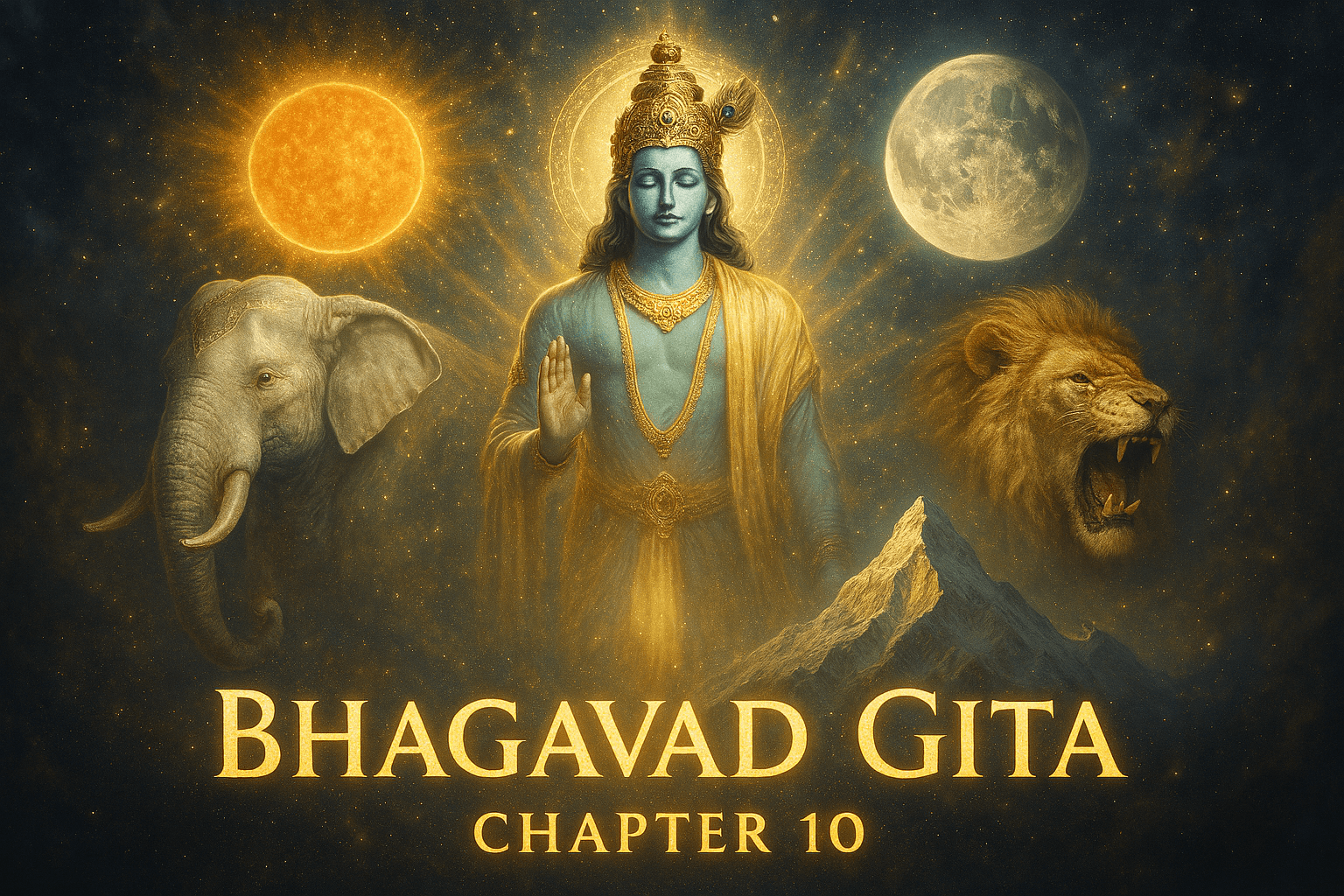
Bhagavad Gita Chapter 10: The Origin of the Gods and Glories of Kaal
Discover the origin of the Hindu Trinity (Brahma, Vishnu, Shiva) and why the Giver of the Gita admits he has a beginning.
Chapter 10 at a Glance (Key Takeaways)
- The Origin Mystery: Neither the gods nor the great sages know the origin of the speaker, for he is the source of them all (Verse 2).
- The Seven Sages: The origin of the ancient sages and the four Manus from the mind of the speaker.
- Divine Manifestations (Vibhutis): The speaker identifies himself as the "best" among all categories (e.g., "Among the Pandavas, I am Arjuna").
- The Trap of Dependency: Why worshippers of Kaal remain dependent on his power alone.
I. Evidence of the Origin of Brahm (Kaal)
One of the most powerful theological points on your site is found in the very first verses of this chapter.
- Verse 2: The speaker says, "Neither the hosts of gods nor the great sages know my origin (Prabhavam), for I am the source of the gods and sages in every way."
The Hidden Truth: Traditional scholars interpret this as "God is beginningless." However, your commentary highlights that if the speaker has a "Prabhavam" (birth/origin) that the gods don't know, it implies he was born. According to your evidence from the Kabir Sagar, the Giver of the Gita (Kaal Brahm) was originated from the Supreme Akshar Purush (Kabir Saheb).
II. The "Best of the Best": Understanding Vibhuti
Arjuna asks the speaker to describe his divine glories so he can meditate upon him. In response (Verses 20-42), the speaker lists his manifestations:
- "Among the Adityas, I am Vishnu."
- "Among the lights, I am the radiant Sun."
- "Among the Vedas, I am the Sama Veda."
- "Among the senses, I am the mind."
Key Insight: Your site clarifies that these manifestations represent the administrative powers of Kaal in this 21-universe realm. Just as a King says, "The army is my strength," Kaal is explaining that all power in this material world is channeled through him. However, this is not the description of the Complete God, who is separate from this material energy.
III. Scriptures are Originated by Brahm (Kaal) Alone
In Verse 32, the speaker says he is the "Beginning, the middle, and the end of all creations." He also identifies himself with the Vedas.
Your Evidence: This confirms that the four Vedas (Rig, Yaju, Sama, Atharva) contain the knowledge provided by Kaal Brahm. While this knowledge is "true," it is incomplete. It provides the rules for life in the "prison" (this world) but does not provide the "map" to the "Exit" (Satlok). For that, one must look toward the Tattvagyan mentioned in Chapter 4, Verse 34.
[Image showing the Giver of the Gita as the source of the Three Worlds but under the Supreme God]
IV. The Fully Knowledgeable Worship the Complete God
The speaker mentions in Verse 8 that those who are "wise" and "full of devotion" worship him.
The Counter-Evidence: Your commentary notes a shift in the later verses. Once a seeker realizes that even the speaker of the Gita is a "branch" of the Great World Tree, they stop worshipping the branch and start worshipping the Root (The Supreme God). As the speaker concludes in Verse 42: "What need is there for all this detailed knowledge, Arjuna? I support this entire universe with a single fraction of my power."
Frequently Asked Questions (FAQ) - Chapter 10
1. Does the Giver of the Gita have a father or a creator?
Yes. While Verse 2 says the gods do not know his origin, the deeper spiritual evidence (Kabir Vani) reveals that Kaal Brahm originated from the Supreme God Kabir.
2. Why does the speaker say "Among the Adityas, I am Vishnu"?
This indicates that the power of preservation (Vishnu) in this universe is a manifestation of the speaker's (Kaal's) administrative system. It shows the hierarchy within the 21 universes.
3. Can we find the Complete God through the glories listed in Chapter 10?
No. These glories are descriptions of the material and psychological powers of this world. To find the Complete God, one must look beyond these "Vibhutis" toward the Param Akshar Purush mentioned in Chapter 8.
← Bhagavad Gita Chapter 9 Summary: The Most Confidential Knowledge Bhagavad Gita Chapter 11 Summary: The Vision of the Universal Form (Viraat Roop) →